Central region cane grower, Colin Vassallo, was the earliest adopter of SRA9, becoming the first to plant it commercially 20 years ago while it was still an unreleased seedling progressing through Bureau of Sugar Experiment Stations (BSES) breeding trials. Mr Vassallo, who farms cane with his wife Georgina, and son Colin Jnr at Septimus, west of Mackay, saw enough promise in trial results, that he asked for some planting material, to test it under his own conditions.
“We first got it (SRA9) in 2005, we got five sticks from BSES,” Mr Vassallo recounted. “At the time we were doing a row-spacing trial with SRDC (Sugar Research and Development Corporation), and I asked BSES if we could have some other varieties to trial and they allowed me to walk through their plot of promising varieties.
“I chose about four varieties and SRA9 was one of them. The others (turned out to be) simply no good. But this one stood out a mile.”
From five sticks to a farm mainstay
Over time, the high-yielding clone, proved why it had stood out in the trial plots.
“Those first five sticks that we got, stretched out to about 10 metres or so, and when we cut it – I cut it by hand – there was just so much more cane in it, we ended up calling it HP, for ‘high producer’, and that’s how we identified it,” Mr Vassallo said.
“We found it to have probably 10 to 20 percent more cane in it than other canes. Eventually we planted a couple of hectares of it, and we found it to be extremely good. It was cutting between 120 to 150 tonnes to the hectare.”
A variety built on reliability
Two decades on, SRA9 is now one of the mainstays of the Vassallos’ farming business, making up 40 per cent of their cane production. Mr Vassallo says its greatest strength is not just peak yield, but its ratoonability.
“Where we first put that couple of hectares in, I now have tenth ratoon, and it’ll do somewhere between 90 to 100 tonnes to the hectare, which is not
too bad,” Mr Vassallo said.
“Plant cane, we’ve always found it to be excellent. It’s a very, very reliable striker. It grows properly; it doesn’t do anything silly.
“If there is a high smut population in the area, you’ll see a few sticks with smut. But it hasn’t affected the crop.”
Where SRA9 fits best
Mr Vassallo believes SRA9 is well suited to lighter soils, where it has proven particularly dependable on his Septimus farms.
“It will grow in a heavy soil, but the heavier soils tend to get a little bit wet for it at early stages. It doesn’t like being wet too early. But in the lighter soils, it’s very dependable.”
That observation has also shaped how the Vassallos manage the variety after harvest. They avoid overwatering SRA9 immediately after cutting, preferring a light irrigation if conditions are dry.
“I’ve found over the years, after it’s harvested, I don’t irrigate it too much – just a light watering,” he said. “It doesn’t like being cut and getting real wet. But it will recover from it, if it does rain a lot, it’ll recover; it’ll just take longer.”
In Mr Vassallo’s view, SRA9 is not “a flashy” early season variety. Instead, he says it grows steadily and holds on. That growth habit can make the crop look unremarkable early in the year, only to reveal its bulk later as it ripens, making it a mid-to-late harvest variety.
“It’s not terribly fast growing. It’s just a constant growth. It tends to grow through the winter, and come May, you think, ‘geez there’s not all that much there’,
but then you see all the tops ripen up and it was there alright. So, it’s (harvested) from August on,” he said.
One challenge with SRA9, that Mr Vassallo notes, is that the very high-yielding crops can lodge, creating extra work at harvest.
“If it’s a really big crop, it can lie down both ways and it can be a bit of a problem for the harvesters,” he says. “But (in saying that) it’s always been able to be harvested. So, it’s better to have a big crop there, than no crop there.”
Mr Vassallo acknowledged that SRA9 can carry slightly lower CCS than some other varieties, but said the result depended strongly on the crop and the season.
“It does tend to be half a unit lower,” he said. “However, if it’s a crop that’s straight and dry – it’ll test
more than other varieties.”
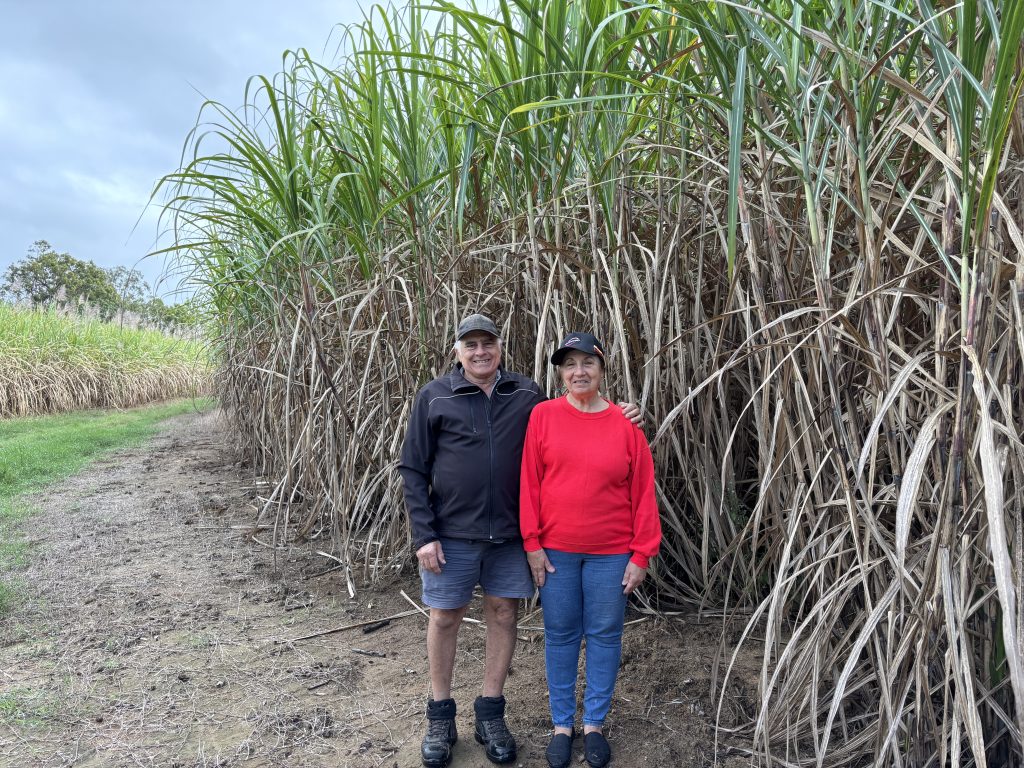
(Above): Cane growers, Colin and Georgina Vassallo with a crop of SRA9 on their Septimus farm, west of Mackay