Compared with whole‑stick planters, billet planters typically require growers to plant three to four times more seed cane to overcome the system’s limitations.
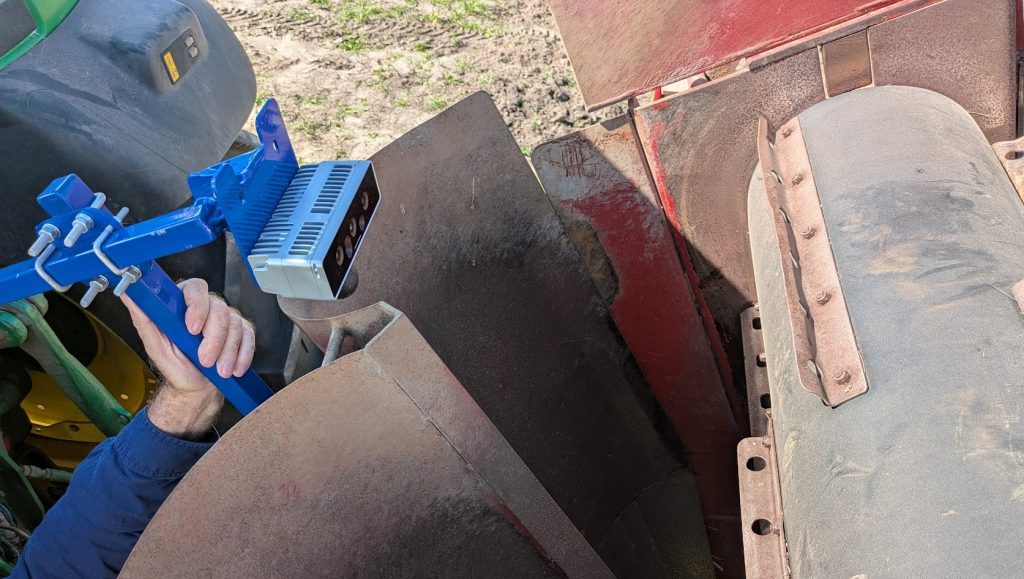
A new project aims to address these challenges through the development of an AI‑enabled system capable of measuring billet planting rates and assessing billet viability on the planter. The project’s primary objective is to achieve a more uniform strike with fewer gaps while using less seed cane.
Fully funded by the Department of Primary Industries, the work builds on previous collaborations between SRA and Griffith University, and brings together specialists from DPI, SRA and Scan Consulting, led by Griffith University Research Fellow, Rudi Bartels.
Currently planter operators make a visual assessment of the volume of billets being planted to control the billet flow but they cannot accurately assess seed‑cane quality nor control the planting rate as can be done with grain planters, for example. In particular, there is no measurement of the viable eyes being planted per metre. The units used to measure planting rates are tonnes per hectare – a very crude measure that often leads to significant overplanting. This is because the operators have no means of seeing how many viable eyes they are planting.
Overplanting has become the default risk‑management strategy to overcome the lack of visibility and control as to the number of viable eyes being planted.
The AI system will also be trialled on the harvester to provide early warnings of seed quality issues.
Other areas under investigation include understanding planter configuration impacts, improving uniformity across multi‑row planters, assessing closed‑loop billet‑feed control, providing manufacturers with quantitative feedback to improve planter design, and demonstrating benefits and yield impacts.
Key outputs include field trials of planter configurations/setups and final recommendations for planter design and industry adoption.
A low‑cost, easy‑to‑use tool that measures nodes planted per metre in real time would enable growers to make informed decisions and could reduce seed‑cane requirements.
Reducing the number of gaps while planting could provide an estimated 1% yield increase adding a further $29 million per year to the industry. Training, extension activities, and potential technology licensing are integral components of the project to assist in adoption.
Acknowledgements
This project is fully funded by the Department of Primary Industries.