
Exotic pests and diseases present a significant threat to the continued security of cane supply for the Australian sugarcane industry.
Cooperating with state governments, Plant Health Australia (PHA) and the Australian Government Department of Agriculture, Fisheries and Forestry (DAFF) to ensure early detection of incursions is listed as one of the priorities in the Crop Protection Plan in SRA’s 10-Year R&D Plan.
Breeding disease and pest resistant varieties and conducting quarantine and disease-free seed cane programs to prevent the spread of pests and diseases within Australia are also high priorities.
If you suspect that you have seen any exotic pests or diseases, contact your local productivity services group or the Exotic Plant Pest Hotline on 1800 084 881.
Managing biosecurity
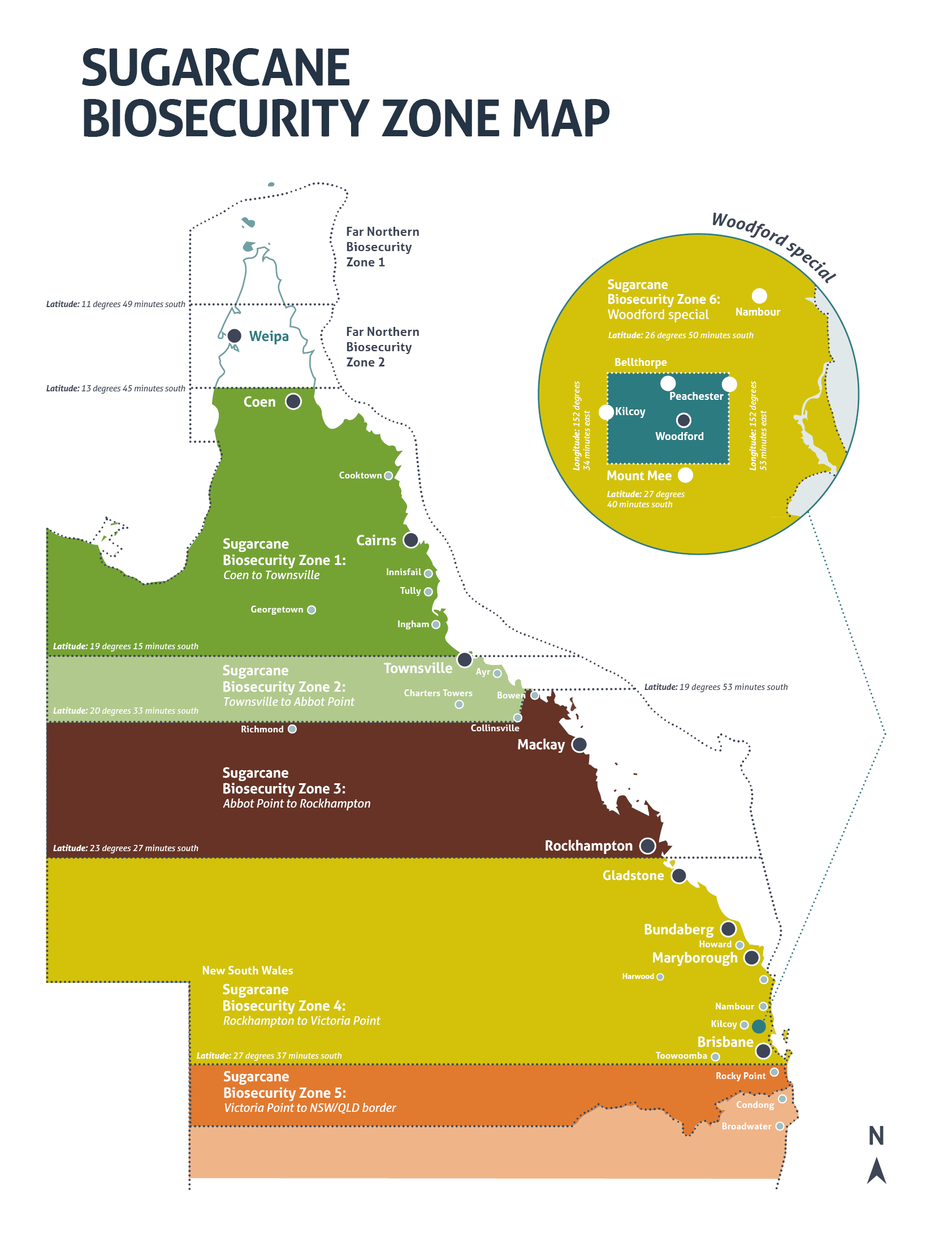
Sugarcane Biosecurity Zones within Australia
Quarantine has never been more important to the Australian sugarcane industry than it is today. Fiji leaf gall, leaf scald and mosaic disease are three potentially devastating diseases that are present in Australia but are now under active control.
Quarantine between Sugarcane Biosecurity Zones in Australia has helped the industry restrict the spread of these serious diseases. While Fiji leaf gall caused massive losses in the Bundaberg district in the 1970s, it has never been found north of Proserpine due to strict internal quarantine regulations.
Queensland’s Biosecurity Act 2014 and Biosecurity Regulation 2016 control the movement of sugarcane and sugarcane machinery between Queensland’s sugarcane biosecurity zones, and controls pests and diseases within these zones.
Border protection
The use of quarantine as protection against pest and disease incursions is a vital safeguard for our industry and one of our high priorities.
We provide support to the Department of Agriculture, Fisheries and Forestry which has the primary responsibility for international quarantine. The Department has comprehensive border controls to screen imported goods, plant materials and travelers entering Australia.
Our scientists been undertaking offshore research in foreign places such as Papua New Guinea and Indonesia to identify risks posed by exotic pests and diseases. Serious insect pests of sugarcane, such as the top borer Scirpophaga excerptalis or the island planthopper, which carries Ramu stunt virus, are found not far away from our shores. Incursion management plans have been developed for these pests should they ever enter Australia.
SRA places great emphasis on screening Australian varieties for resistance to exotic pests and diseases in preparation for possible incursions.
Incursion management plans – Preparing for possible incursions of exotic pests and diseases
Being prepared for an incursion of an exotic pest or disease will greatly increase the chances of eradicating the invader, or minimising losses if eradication is not possible.
SRA are working closely with Plant Health Australia and CANEGROWERS to update the Industry Biosecurity Plan for the Sugar Industry which identifies the highest risk pests and diseases and outlines the procedures and resources that are available in case of an incursion. We have also developed detailed dossiers and molecular diagnostics for each of the high priority pests.
Importation of sugarcane varieties
Historically, the Australian sugarcane germplasm population derived from a narrow genetic background. In an effort to enhance the genetic diversity of sugarcane varieties, we have active variety exchange programs with many sugar-producing countries. Australia exchanges elite commercial varieties with countries including the United States, Brazil and Mauritius, and these overseas varieties are used as parents in our crossing program.
All imported germplasm undergoes 10 months in quarantine at the at the DAFF Post-Entry Quarantine (PEQ) facility in Mickleham (Victoria) to ensure that it is free from exotic pests and diseases before being released for utilisation in the SRA breeding program.
No one should attempt to bring sugarcane into Australia without approval from the Department of Agriculture, Fisheries and Forestry.
Sugarcane Biosecurity Zones
Stopping the spread of unwanted pests and diseases is vital for our industry.
Quarantine between sugarcane districts in Australia has helped to restrict the spread of serious diseases like Fiji leaf gall and mosaic.
New procedures
Plant material or machinery that has been in contact with a sugarcane plant, or soil on which a sugarcane plant is or has been growing must have a Plant Health Assurance Certificate (PHAC) to move between sugarcane biosecurity zones.
In the past Inspector Approvals were managed by BSES however this activity is not conducted by Sugar Research Australia.
If you need to move a machine between sugarcane biosecurity zones you should contact your nearest Productivity Service. In most areas some Productivity Service staff have been appointed authorised inspection persons by the Department of Agriculture and Fisheries (DAF) Queensland for the inspection of machinery.
For approval to move sugarcane plants between sugarcane biosecurity zones or for further information visit the DAF website.
Exotic pests and diseases
International travel – biosecurity
If you suspect that you have seen any exotic pests or diseases, contact your local productivity services group or the Exotic Plant Pest Hotline on 1800 084 881. The hotline is staffed during normal working days and business hours. View the exotic pests and exotic diseases web pages for photos of the species to be aware of.
SRA has developed the following protocol for people in the Australian sugarcane industry who are visiting overseas sugarcane growing countries.
This protocol applies to all SRA staff:
SRA staff who travel overseas should be aware of the risks of carrying insects and the spores of fungi on their clothes, notebooks, cameras and any other equipment they may be carrying. Exotic pests and diseases that pose a biosecurity risk to Australia are common in nearly all sugarcane producing countries and fungal spores can easily be carried on clothing. It is mandatory that all travellers who walk through cane fields while overseas launder their clothing in hot water before returning to Australia or immediately on return. Shoes should be thoroughly cleaned by scrubbing with a mixture of hot water and detergent or by swabbing with 70% methylated spirits. Staff who travel to particular locations regularly should consider leaving personal protective equipment in the country of visitation for use on subsequent trips to further minimise risk. Other equipment should be cleaned and disinfected with 70% methylated spirits with particular care to remove all sugarcane residues. These treatments are required to meet the general biosecurity obligation as outlined in Queensland State Law.