Delivery of a pest and disease diagnostic step change for the sugarcane industry
Ratoon stunting disease (RSD) is a major disease limiting sugarcane profitability in Australia, yet the true extent has not been identified or actual monetary losses calculated. This is due to the lack of external symptoms in the field.
Detection is typically limited to testing planting material which requires a lengthy and costly process to identify/confirm RSD presence. In some regions, 30 per cent of crops may be diseased, but little is known about levels in commercial crops.
Correct identification of RSD using a method that is timely and cost effective is the solution to detection and thus management. Application of a molecular RSD assay during milling would immediately provide information on the commercial crop distribution of RSD in the Australian industry.
In the Australian industry, every rake of cane has attached Geographic Information System (GIS) data relating yield, CCS and fibre to individual blocks, farms, sub-districts, planting and harvester contractor groups, soil types, crop cycle information and management practices.
An RSD assay applied to first expressed juice at the mill would enable RSD incidence to be mapped for every mill area for every crop in every year and highlight the factors governing disease incidence. RSD incidence would be pinpointed, allowing focused management to eliminate this yield constraint
Objectives
To finalise the RSD detection protocol for on-mill detection incorporating the inputs and suggestions obtained from several mill representatives.
Expected Outputs
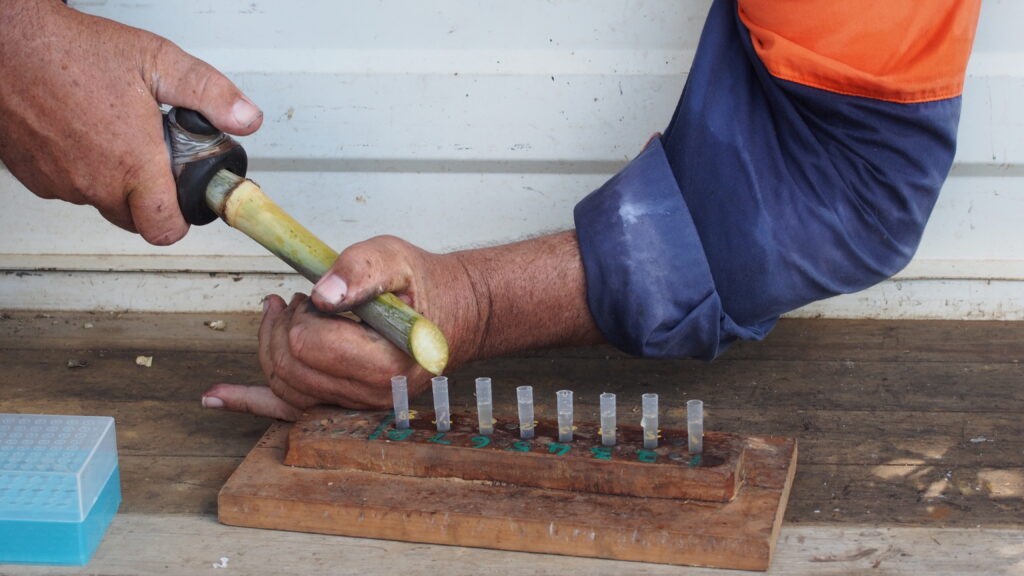
- An optimised molecular Lxx assay for first expressed juice at the sugar factory, based on a dip-stick loop-mediated isothermal amplification (LAMP) methodology.
- Factory staff trained in the operation of these assays
- Gauging of the potential for similar methods to be used for detecting systemic diseases, of both endemic and exotic origin, in cane supplied to Australian sugarcane factories.
Pre-commercial demonstration of the methodology to industry. - Development of a commercialisation plan.
Expected Outcomes
Application of a molecular RSD assay would immediately provide information on the commercial crop distribution of RSD in the Australian industry. This would provide a profound step change to our current knowledge of where the disease occurs and provide for an economic assessment of the commercial effects of the disease in every mill area. Targeted management would then be possible with improved profitability an outcome. Prioritising of the disease, in terms of yield limitation, could then occur in each region, thus providing for appropriate allocation of management resources. Assay results may be extended via communication of the rapid LAMP molecular assay; a report via the sugar factory may be generated.
- For each mill that adopts this assay, it will provide an assessment of RSD levels in every commercial cane field within the corresponding mill area. This will provide a much greater understanding of the true incidence of this disease across the industry.
- Feedback provided from the mill to the grower, particularly when RSD is detected, will encourage growers to adopt the recommended guidelines for controlling RSD and will help growers decide whether to replant or ratoon for the following season guidelines for controlling RSD and will help growers decide whether to replant or ratoon for the following season.
- It will allow prioritisation of the disease in each region/mill area and offer further opportunity to determine the factors leading to
disease incidence, and hence to apply better management Improved productivity and profitability are associated with the lifting of
RSD yield limitations. - Over the long term, there is an opportunity for annual commercial crop surveys across alt mill areas in Australia which can be used for benchmarking methods and progress in managing the disease.
- Opportunity for licencing of the methodology to other sugarcane industries around the world.
- The disease may be causing economic losses of around $80m (unknown currently); this research will both quantify the losses and enable productivity gains up to this figure.
- Successful research outcomes could transform commercial crop disease detection in Australia via the ability to easily assay cane coming into the sugar factory with much GIS information attached. This could be of immense value in both detection of exotic and endemic diseases.
- Once the technology is proven in Australia, it could be commercialised as a ‘service’ to overseas sugar industries as long as it does not provide a competitive advantage. The service could include the deployment and set up of the testing technology and training of milt personnel.
SRA PROJECT CONTACT: Dr Stephen Mudge
RESEARCH AGENCY: Sugar Research Australia
CHIEF INVESTIGATOR: Seona Casonato and Steve Staunton
PROJECT NUMBER: 2022/007
END DATE: 1/4/2028

Acknowledgements
Earlier stages of this project were funded by the Queensland Department of Primary Industries and Sugar Research Australia.