Microwave technology is becoming an increasing part of modern life, with microwave sensors now even able to monitor blood sugar levels in diabetic patients non-invasively. In overseas cane and beet sugar factories, microwave dry substance transducers are used to measure the moisture or dry substance1 content of high grade massecuites by monitoring how the material absorbs or reflects microwave energy.
The technique is touted as improving process control and real time measurement, reducing waste and lowering operational costs through various stages of sugar processing, including evaporation, crystallisation and purification.
The technology is not without its limitations; in particular, it is about ten times more expensive than massecuite conductivity control currently in use by Australian raw sugar factories to control the feed rate of syrup and molasses to pans. Massecuite conductivity works well when teamed with qualified pan operators who are experienced enough to understand the conductivity value is affected by variations in the purity of the cane supply as the season progresses.
A recent project in Mackay shows the high-grade pans can be controlled with the microwave unit alone and by a combination of both microwave and conductivity sensors. However, more work is needed to justify – through productivity gains – the use of a microwave dry substance transducer for controlling high-grade boilings in Australian sugar mills.
The project to demonstrate the use of microwave technology for pan control was undertaken on No.9 pan at Mackay Sugar’s Farleigh Mill.
The project was conducted by Chief Investigators, Mackay Sugar Senior Technologist, Dr Bryan Lavarack, Principal Engineer Operational Technology, Andrew Clews, QUT Research Fellow, Dr Gabriel Fraga and Prof. Ross Broadfoot.
The investigations showed that dry substance can control raw sugar pans and accommodate the range of process conditions regularly encountered throughout a season, including:
- Changes in syrup purity, and
- Vacuum changes.
However, to deliver more accurate control, the project found a combination of parameters was preferable. This was because:
- The microwave transducer had a slower response time to changes within the massecuites compared to conductivity.
- Occasions arose at the start of the project when fine grain was formed in the massecuite. This was attributed to the weak sensitivity of massecuite dry substance in determining the mother molasses supersaturation, control valve settings and variations (impurities) of the dry substance content of the feed material.
As a result, Mackay Sugar used a combination of the process signals from the dry substance transducer and the conductivity transducer for improved control.
The investigators concluded that although dry substance alone (from microwave measurement) can control the feed rate to raw sugar pans, it is preferable to couple conductivity for improved control. Further research work needs to focus on assessing different parameter measurements such as:
- Mother molasses dry substance
- Massecuite consistency
- Boiling point elevation, and
- Feed material solids dry substance,
as well as quantifying the benefits of using these in an improved control scheme.
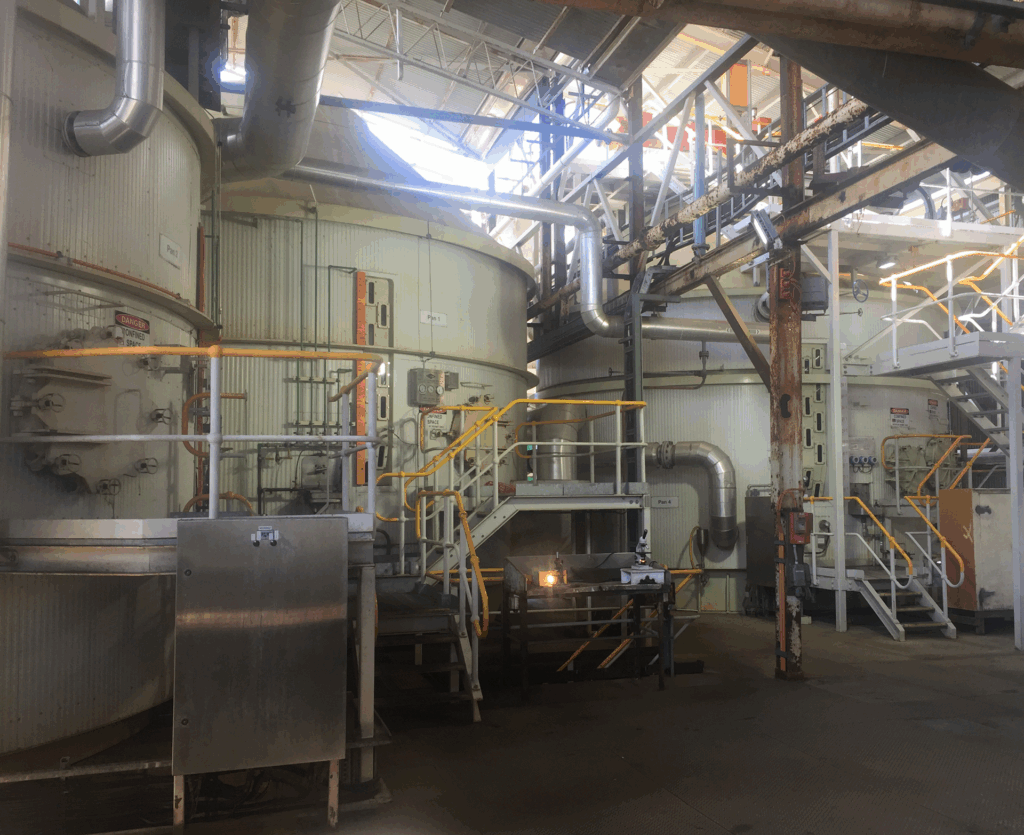
(Top): stock shot of vacuum pans in an Australian sugar mill.
This project was funded under an SRA Small Milling Research Fund grant.
1Dry substance is a measurement of the total solid material e.g. the dense mixture of sugar crystals and molasses (mother liquor) produced during sugar production, particularly in the final stage after most of the water has been evaporated. Its value is crucial for optimising the control of the sugar crystallisation process to produce high-quality sugar, particularly noting the loss of experienced pan boiling personnel throughout the industry.