
Canegrubs are currently the most significant economic pest of sugarcane in Australia.
Canegrubs are the larvae of a number of types of cane beetles. There are 19 endemic and one introduced species of canegrubs in Australia. The larvae, or grub, damage sugarcane through their feeding action on plants roots.
GrubPlan provides detailed information on the identification, biology and management of canegrubs.
It covers canegrub species found in all sugarcane production areas in Queensland and NSW.

All crop symptoms are a result of the feeding activity of the grubs on plant roots. Symptoms may be either above or below ground and may be apparent at different times of the year and crop stage.


- Canegrubs are identified by the hair pattern on the grub’s rear end. The hair pattern is called a ‘raster’.
- To see the raster clearly you will need to use a hand lens with a magnification of 10.
- Hold the grub between the thumb and forefinger with the tail-end facing you with the head downwards. Looking through the lens bring the grub closer until it is in focus.
- Compare the raster pattern with the rasters of grubs common to your growing district. (link to what district are you in)
- To confirm the identity of grubs that look similar you will need to count the number of hairs of the raster or send the grub away for a DNA test.
- If the grub does not have a raster, then it is not a canegrub.
How to preserve grubs for later identification
You can easily preserve a grub for later identification by putting it into a container of water with a squirt of detergent.
After a few minutes, rinse out the dirty water and refill with 60-70 per cent methylated spirit.
Canegrub Raster Patterns
Canegrubs have a lifecycle consisting of egg, larva, pupa and adult stages. The cycle begins with eggs laid between October and February. Timing of egg laying may differ slightly between species and from year to year, depending on climatic conditions.
Eggs hatch into larvae, which go through three growth stages called “instars”. After the third-instar has accumulated enough fat reserves they burrow downwards and pupate. Pupa metamorpize into adult beetles which remain in the soil until triggered to emerge by temperature and rainfall.
Adult beetles usually emerge around dusk and form dense flights from about 7.00 pm. Beetles seek out feeding trees and mate. Female beetles usually feed for about two weeks while their eggs mature. They then return to the soil to lay their eggs.
Egg-laying beetles tend to be attracted to blocks where cane is taller than adjacent blocks, or sometimes to blocks on hillsides which may appear taller than cane on other blocks.
Canegrub species differ in their geographic distribution and their lifecycle may extend over either one or two years.
Being native insects (except for plectris canegrub), there are a number of natural enemies that help to regulate canegrub populations.
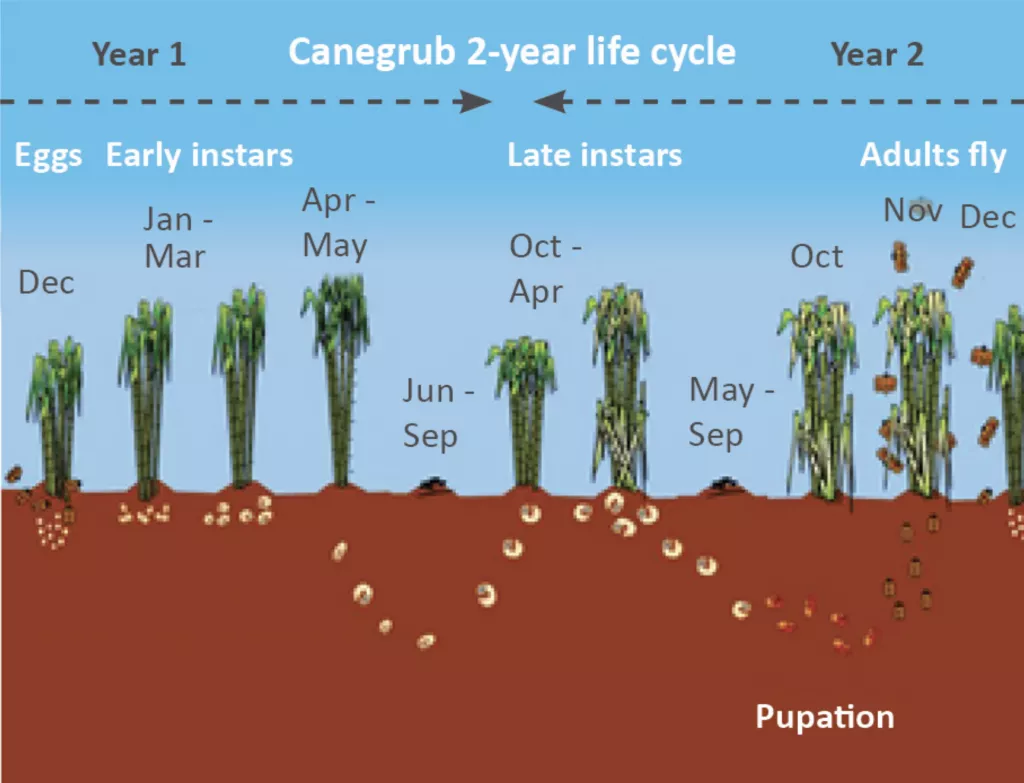
Two-year lifecycle
Two-year lifecycle canegrubs generally extend their lifecycle by the second-instar “hibernating” deeper in the soil over winter in the first year. In spring, these return to the root zone, continue feeding, moult to form third-instars and burrow deeper into the soil to pupate. This extends their lifecycle compared to one-year canegrubs.
Seasonal weather conditions also influences the timing of lifecycles.
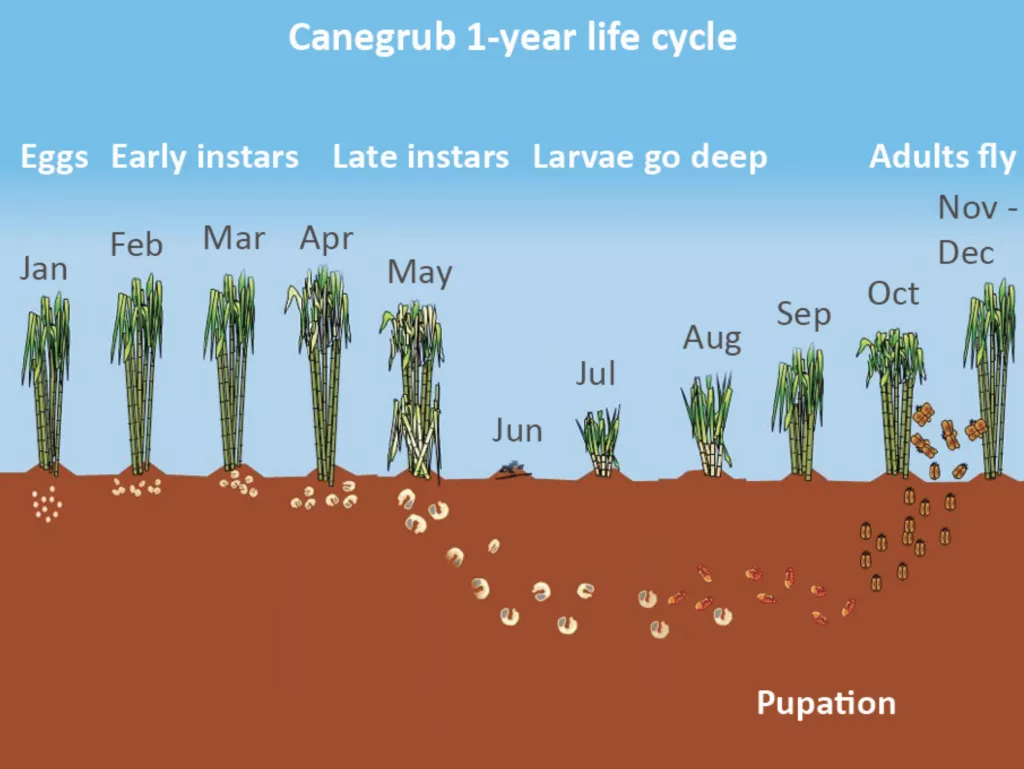
One-year lifecycle
One-year cycle canegrubs complete their lifecycle within twelve months, as per the generalised lifecycle below.
Timing of lifecyles vary between regions and between seasons, due to climatic differences. Mass emergence of adults within a short time period results in concentrated beetle flights and subsequent egg laying. At other times, weather conditions may result in a staggered emergence of adults resulting in beetle flights and egg laying spread over a longer time period. This often results in a mix of instars being present in cane blocks.
Typical regional lifecycle idiosycnrosies
REGIONS
Northern to Central
Southern
EGG LAYING
December – January
September – October
AGRESSIVE FEEDING
March – May
March – May
Calibration of Application Equipment
Accurate calibration of application equipment is required as only a relatively small quantity of insecticide needs to be distributed evenly and at the correct rate over the block to be treated.
Granular (suSCon® maxi intel) applicators – ground driven
Ground-driven applicators have both a driving cog and a driven cog. The driving cog is turned by the ground wheel and is connected to the driven cog by a chain. The driven cog turns the worm feed in the bottom of the granule hopper box.
Depending on the mix of cog sizes you have available, it is possible to change the output by changing either the driving cog or the driven cog; or both changing both the driven and driving cogs.
Liquid insecticide applicators
Liquid applicators should be designed to deliver at least 1.5 L of water per 100 m of treated row.
The following Information Sheets describe each method:
Trap Cropping
Trap cropping was developed for the Burdekin district as part of an integrated control program for greyback canegrub. It is effective where the topography is flat but less effective in other areas with broken topography. Trap cropping aims to manipulate the harvesting and planting sequence to attract egg-laying beetles to specific cane blocks.
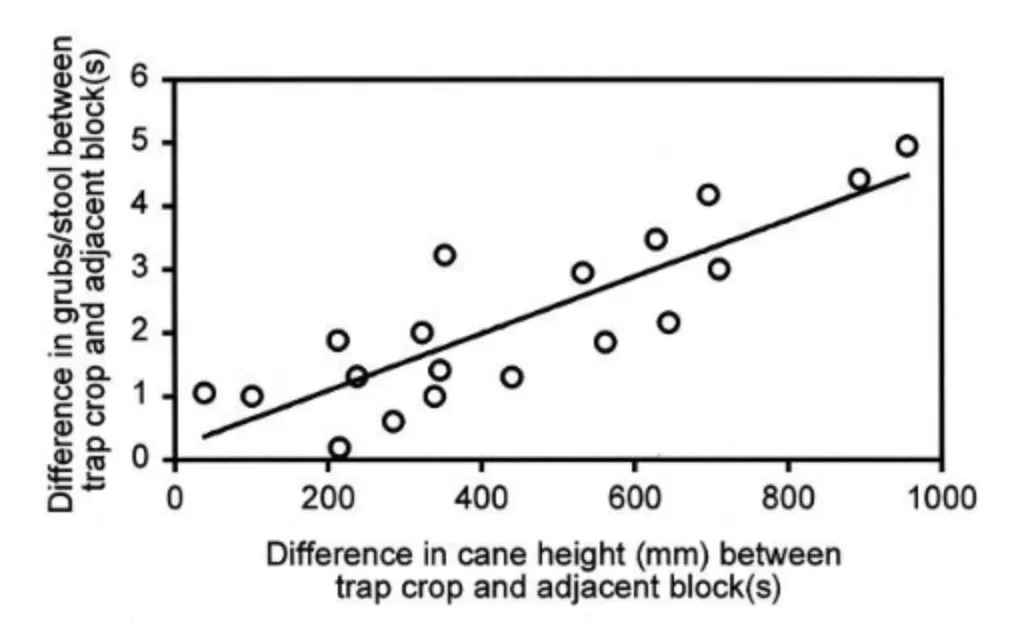
Trap cropping works by taking advantage of cane beetles’ attraction to early-harvested cane that is significantly taller than surrounding cane. The greater the height difference between a trap crop and surrounding cane, the more effective this strategy is likely to be.
Early planted cane blocks
Early planted cane blocks can focus grub pressure into early-planted fallow cane which has been treated with insecticide. This helps to reduce the grub pressure on later planted cane and ratoons. Early cut seed cane blocks are suitable.

Ratoon trap crops
Ratoon trap crops can be created by early-harvesting either whole blocks or sections of blocks. Older, low yielding ratoons due to be ploughed out can be early-harvested, then cultivated out in February-March to kill grubs.
Younger, higher yielding ratoons can still be used as trap crops by early-harvesting then treating with imidacloprid to kill any subsequent infestation of grubs.
Trap crops should be in close proximity to sections of the farm known to suffer grub damage. Use a minimum of eight rows for an effective trap crop. Usually a number of trap crops are needed, with the number increasing if the terrain is hilly.
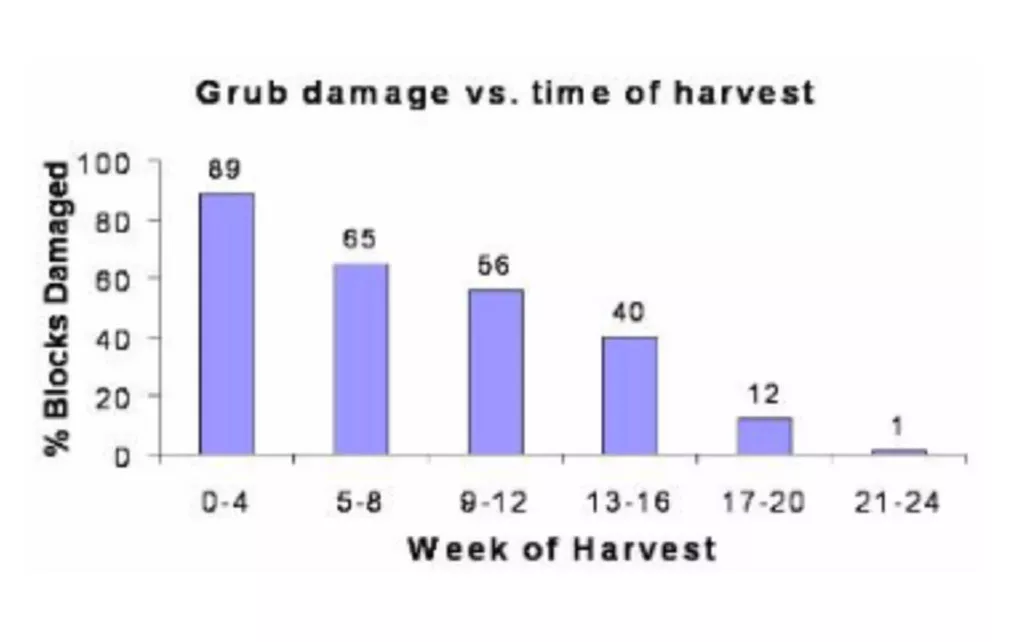
These graphs show that greyback canegrubs are attracted more to taller cane
Forage sorghum also attracts egg-laying beetles and can be used as a trap crop. Cultivate the sorghum out during February to March to kill grubs.
Monitoring allows informed treatment decisions to be made. Unlike many other pests in other crops, canegrub treatments usually need to be applied when the pest is not present. Therefore treatment decisions are made on a risk assessment based on historical infestation, presence of canegrubs in an earlier crop and an assessment of the likelihood of future infestations.
Monitoring and risk assessment procedures have been developed for Childers, Bundaberg, negatoria and southern one-year canegrubs in the southern regions and for greyback canegrub in northern regions.
Central and northern regions – greyback canegrub
Monitor for greyback canegrubs when they are actively feeding and large enough to find under stools:
- Central – April/May
- Burdekin – February
- Northern – March
Check for crop symptoms in standing cane before harvest
Check for gaps in ratoons after harvest
Root pruning and gouging of stools will confirm that symptoms in standing cane and gaps in ratoons were due to canegrubs
Presence of greyback canegrub in the current year indicates a high likelihood of a new infestation in the next year. Even if the infested block is taken out, the adults will still emerge and potentially re-infest the same field if it is plough-out replanted or another nearby field.
Southern regions
Monitoring in autumn allows time for planning treatment strategies in spring
Two-year canegrubs present at autumn sampling will be the same grubs that cause damage in spring
Check ratooning blocks for crop symptoms
One-year canegrubs present at autumn sampling will not cause damage in spring but are an indication that a new infestation is likely to cause damage next season.
Currently, imidacloprid represents the sugar industry’s best canegrub management tool, but it is highly soluble in water and moderately mobile in soil, therefore prone to end up in aquatic environments.
Imidacloprid has been detected in many water bodies including groundwater, creeks, rivers and marine environments, posing a potential risk to the health of the Great Barrier Reef. To limit imidacloprid losses via runoff, only apply the treatment when required (strategic treatment decision based on monitoring and risk assessment).
Where treatment is required, imidacloprid application must be precise, consistent and follow the label recommendations.
More information is available in this report: Impact of application depth and slot closures on runoff losses on imidacloprid.