A project led by Line Williams, Wilmar’s Environment and Production Technologist, and Anthony Mann, Mechanical Engineer at QUT’s Centre for Agriculture and the Bioeconomy, has found that the national regulator’s figure used to estimate nitrous oxide (N₂O) emissions across the sugar industry is very likely to be too high.
The National Greenhouse and Energy Reporting (NGER) scheme uses an emission factor to estimate N₂O emissions from bagasse fired boilers in the industry. N₂O emissions from boiler stacks are the largest single source of reportable emissions for the milling sector. The sugar industry is under increasing pressure to reduce reportable greenhouse gases and a June 2023 report on Australian sugar milling research priorities identified Net Zero as a priority area.
In a Small Milling Project which concluded in June, the emissions from 22 different types of milling boilers firing bagasse were measured. Both the mean (at 0.64) and the median (0.41) of the calculated emission factors found in the project were well below the NGER emission factor (1.1).
However, the emission factor measured for methane (CH₄) was less clear. The mean emission factor (0.47) was more than the emission factor used by NGER (0.3), but the median factor (0.03) was much less than the NGER emission factor (0.3). Combustion conditions were thought to be the reason for the strong variations in emissions factors found in the project.
The effects of boiler operating conditions such as excess air, overfire/underfire air split and steam output were examined with the following conclusions:
- A weak correlation exists between increasing excess air in the boiler and increased emissions of N₂O but reduced emissions of CH₄.
- An increased proportion of overfire air looks likely to reduce emissions of N₂O and CH₄, but more readings are needed to make this result statistically significant.
- A slightly negative correlation exists between N₂O emissions and boiler loading as a percentage of the boiler’s maximum continuous rating (MCR).
- No correlation exists between CH₄ emissions and boiler loading as a percentage of a boiler’s MCR.
Emissions of N₂O and CH₄ during boiler start-up when combustion changes from grate combustion to suspension combustion were also investigated and it was found that grate firing results in higher N₂O emissions than suspension firing.
The measurements carried out in the project indicate that wet scrubbers used in the industry do not have any statistically significant effect on N₂O and CH₄ emissions. This could be because both N₂O and CH₄ have low solubilities and reactivities with water at the temperatures encountered in standard wet scrubbers. Consequently, there is unlikely to be any dissolved N₂O or CH₄ in scrubber water.
Examining options to remove N₂O from boiler flue gas the project team found most of the process or technologies used to reduce emissions of nitric oxide (NO) and nitrogen dioxide (NO₂) either caused no change in N₂O emissions or an increase. Some researchers found staged combustion could reduce N₂O emissions. Others found no change or an increase. Others found the addition of a second fuel stream after the burnout of the main fuel (reburning) could significantly reduce N₂O emissions.
Measurements and calculations from the project strongly suggest the regulator’s emission factor for N₂O emissions from bagasse fired boilers is too high. However, further work is required to more thoroughly investigate these preliminary conclusions.
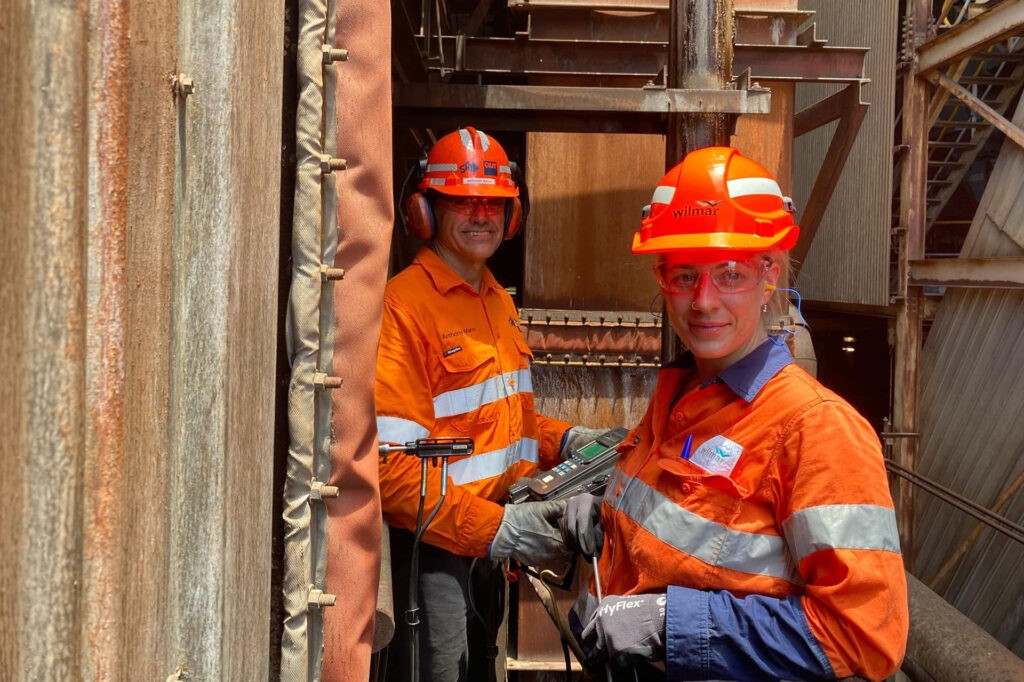
(Above): Anthony Mann and Line Williams at work at Invicta Mill taking flue gas measurements from one of the boilers using a portable gas analyser.
This project was funded by SRA and Wilmar under the Small Milling Research Project investment scheme which was developed to deliver investment in relatively low cost, short-term, industry-identified and industry-led research projects.