Heavy cracking clay (gluepot) and sodic soils are currently not well represented in SRA’s Final Assessment Trials (FATs) for new varieties. Growers at shed meetings at the start of the season each year commonly ask what varieties will perform in these challenging soil types.
SRA Central District is aiming to provide additional information to growers to answer this question as part of the District Plan.
Two commercial scale demonstration sites on challenging soils have been billet planted across the district this year. These sites will be commercially harvested and individual rake data collected next year, and annually for ratoon crops.
These first two demonstration sites host QC11-915 and a released standard of Q240 or Q253 for comparison. QA08-2979 was planned for billet planting, however, it was discarded by the Regional Variety Committee (RVC).
The aim is to complement what is already being collected from SRA FAT trials and observation plots managed by the productivity services companies.
A second set of four demonstration sites with the promising varieties, Q11-915, SRA29 and WSRA17, compared with a known variety, will be billet planted in 2026 from material that has already been stick planted onto these farms.
In addition, a demonstration of root systems of different varieties, quantifying their root growth is underway. Root systems are an area of interest under the District Plan and this activity is following an assessment process utilised overseas. The demonstration has been set up with sufficient replicates and randomisation to allow for statistical analysis.
SRA Central District Manager Dylan Wedel said these small-scale District Plan activities aimed to improve growers’ knowledge of new varieties to maximise their value and improve adoption.
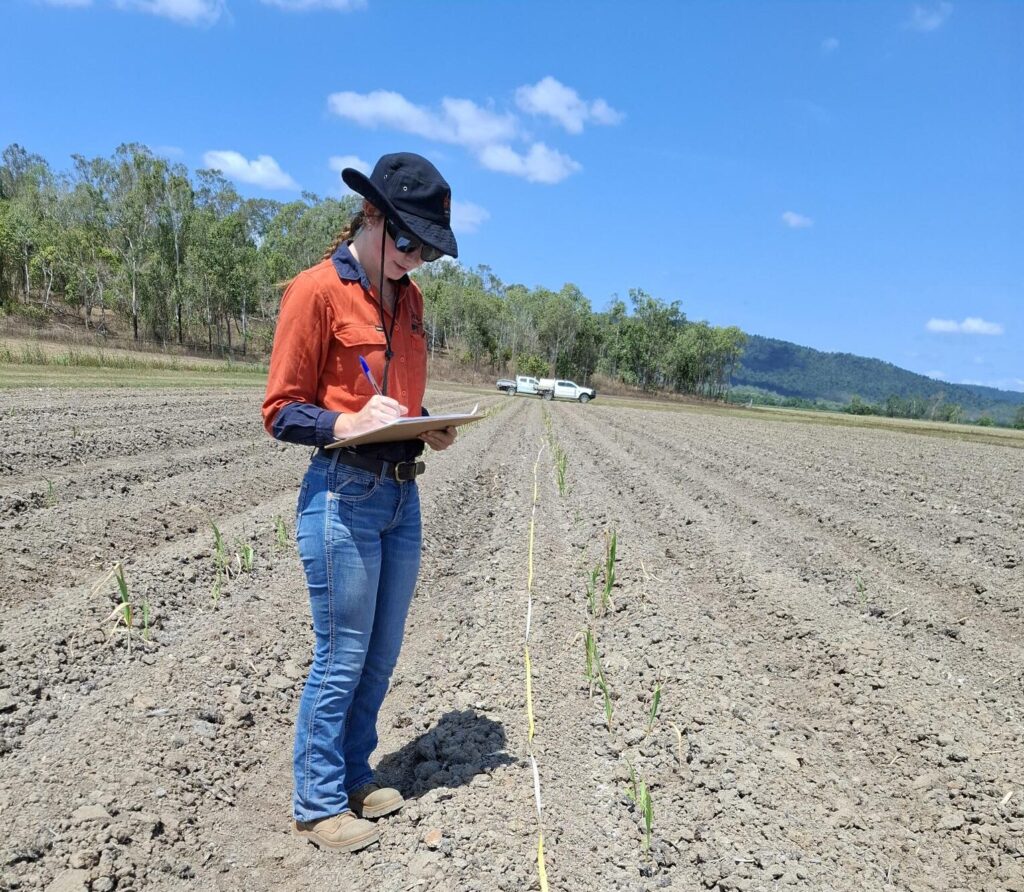
(Above): Hayley Keats, Assistant District Delivery Officer is pictured working on the trials.