
Other diseases include Nematodes, Mosaic and Yellow Canopy Syndrome, among other diseases. See information sheets available on this page.
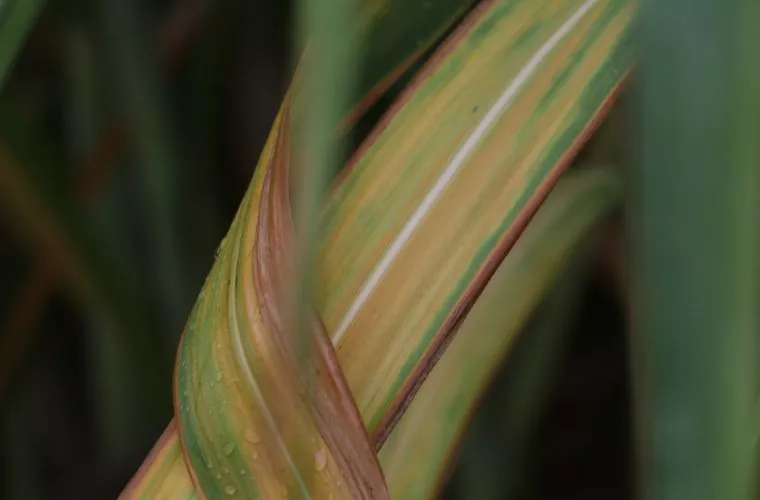
Yellow Canopy Syndrome (YCS) is an undiagnosed condition affecting the Southern, Central and Northern cane-growing regions.
Key Symptons:
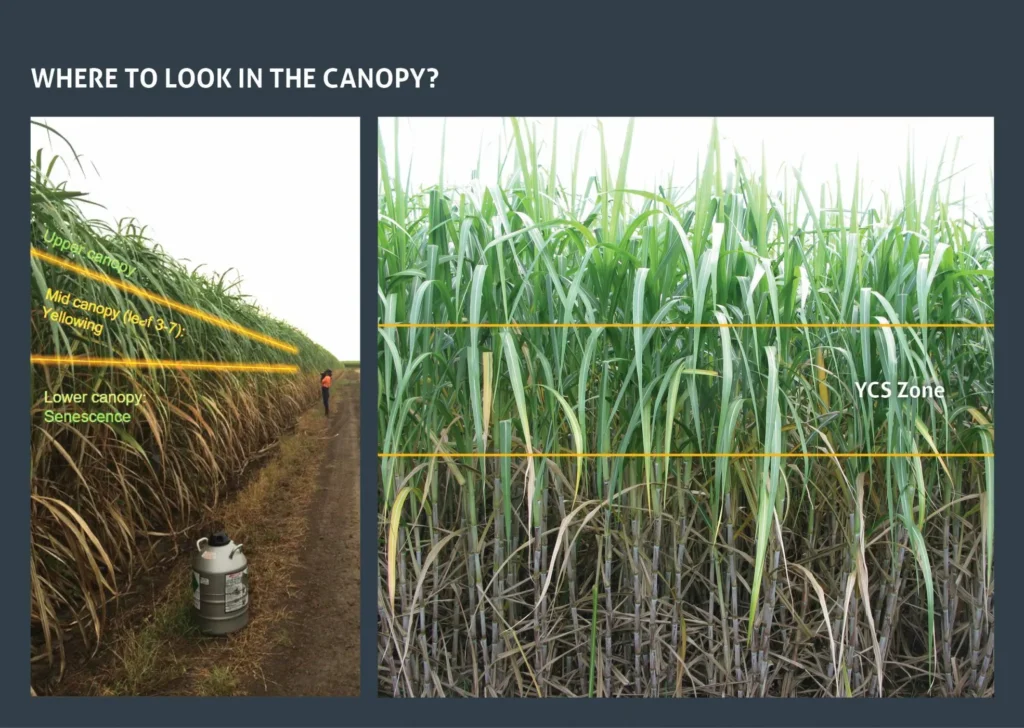
- Overall the crop generally looks quite orange-yellow, with the yellowing extending into the youngest leaves in the worst affected crops.
- Young leaves show faint yellowing at the tip. This progresses to a stronger yellowing generally to one side of the leaf and towards the leaf tip.
- Leaves 5 or 6 generally show uneven coarse mottling, with areas of uneven green and yellow tissue developing.
- Unlike typical viral or nutrient deficiency symptoms, this symptom is uneven, and looks more like a stress condition or herbicide effect.
- It extends right down the leaf blade.
- The midrib remains white and is the last part to turn yellow.
- Leaves in the lower canopy are more uniformly yellow, showing areas of brown-black necrotic spots.
- Leaf tips and some margins begin to die, with older leaves senescing earlier.
- Once affected, yellow leaves do not recover. In extreme cases, cane stalks may become thin and rubbery and root health is compromised.
- Symptoms may also ‘come and go’ in waves.
Information sheets for other diseases
Other diseases.
Identifying YCS
Cane can turn yellow for a variety of reasons including drought stress, phytotoxicity (or herbicide damage), insect attack, disease, nutrient deficiency or natural maturing. It is important to understand how symptoms that are commonly observed from each of these causes and how they differ from YCS.
Our researchers have documented and examined YCS and noted the difference between it, and the natural leaf yellowing which occurs in every growing season. YCS has been clearly described so that everyone can be assured that those researching the condition and the general farming community are referring to the same thing.
What we know so far
Experimental work does not support a single cause for YCS. There are a range of activities underway looking at several possible options.
There are many causes of leaf yellowing in sugarcane. YCS is a specific pattern of leaf yellowing accompanied by abnormal and lethal accumulation of sucrose and starch in leaves.
Additional magnesium application above levels recommended for good crop management has no effect on YCS expression.
Magnesium deficiency in sugarcane can lead to yellowing of leaves. Experiments now confirm that addition of magnesium does not prevent or alleviate YCS symptoms. Plants with YCS usually have adequate levels of magnesium so magnesium deficiency is not a cause of YCS.
The role of insects, phytoplasmas, other bacteria in combination with environmental triggers are being investigated.
Experimental work does not support a single cause of YCS. A number of factors need to be present for YCS to be expressed. Experimental work is focused on identifying the key factors so that management options can be progressed.
An indicator toolkit for SRA, productivity service organisations and industry advisors for identifying YCS is at an advanced stage of development.
This is a significant step as any approach, experimental or commercial, needs to correctly identify the problem so that researchers and industry can respond appropriately.
A chemical option is under investigation which in most cases prevents YCS symptoms expression under experimental conditions.
This is a vital step if researchers are to develop management options for industry. These trials have used a broad-spectrum insecticide at high doses as an experimental tool to confirm or eliminate the role of an insect in YCS.
This is not a test of the suitability of these chemicals as a management option. This option is enabling us to quantify the impact of YCS on yield and identify potential causes. This means that researchers now have the capacity to manipulate YCS symptoms.
Answers to common grower questions
It has been difficult to assign yield losses solely to YCS except in cases where blocks were severely affected and where repeated waves of yellowing were observed over an extended period of time.
YCS can impact cane in a number of ways. This can range from yellowing in one or two leaves to yellowing right through the canopy. Depending on the degree of symptoms, crop growth can be compromised with potential impacts on final yields. YCS symptoms may ‘come and go’ in waves through the season.
Some growers have reported that fields affected last year are not yet showing YCS symptoms, while others report that YCS is present again.
YCS can impact cane in a number of ways. This can range from yellowing in one or two leaves to yellowing right through the canopy. Depending on the degree of symptoms, crop growth can be compromised with potential impacts on final yields. YCS symptoms may ‘come and go’ in waves through the season.
If you notice yellowing in your crops ensure that you check the symptoms with your local productivity services group. They will help confirm whether you have YCS.
Until we identify the cause of YCS, we cannot advise about on-farm management strategies to treat it. However, as part of our research program we are investigating a number of management strategies to see how they impact on YCS. Therefore, we recommend that crops are well managed with optimised inputs.
It has been suggested that YCS may be transmitted in planting material. Although our current trials that look to answer this question are still in progress, we have noticed that when growth conditions are ideal, no yellowing has occurred.
We therefore encourage growers to use approved seed cane where possible and to adopt good farming practices.
Harvesting YCS-affected cane
I am text block. Click edit button to change this text. Lorem ipsum dolor sit amet, consectetur adipiscing elit. Ut elit tellus, luctus nec ullamcorper mattis, pulvinar dapibus leo.