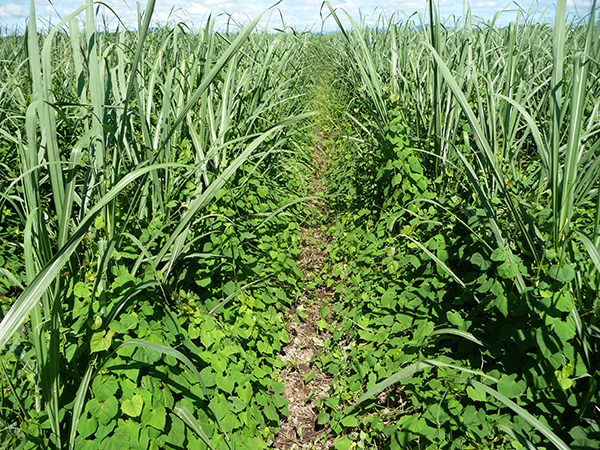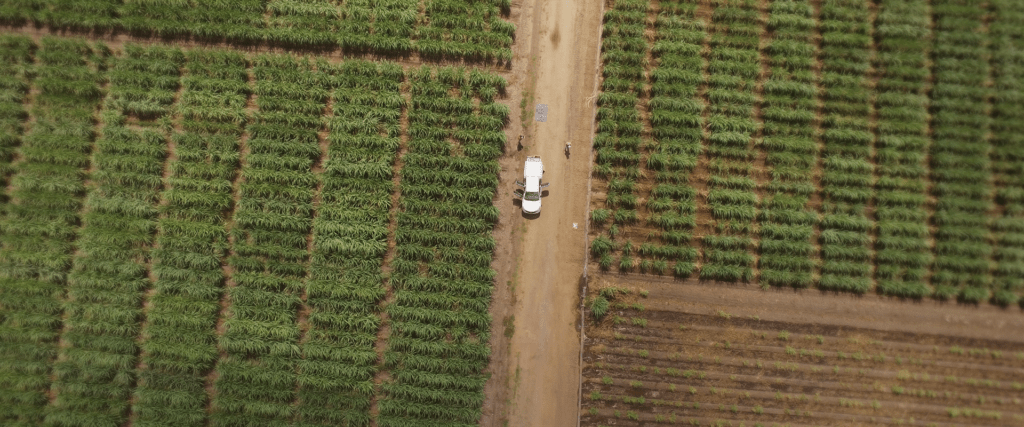

Some growers argue that only when SRA’s sugarcane varieties are planted out on farms with different soils, microclimates, and varying water and nutrition, can a variety’s true potential be proven.
General Manager Variety Development, Dr Garry Rosewarne, agrees. He plans to introduce Regional Assessment Trials (RATs) following Final Assessment Trials (FATs). These will be elite clones grown in diverse soil types and harvested under commercial conditions. Trials will also be grown out to four ratoons to obtain robust commercial performance data before the variety is released.
Plans are also in place to improve efficiency and in an exciting development, SRA has begun deploying genomics* techniques as a huge step forward in designing new sugarcane crosses*.
Industry important traits such as tonnes of cane per hectare (TCH), CCS, fibre, and resistance to smut and Pachymetra, are controlled by thousands of genes* due to sugarcane’s complex genome*. Over the past seven years research has proven that genomic scans of clones can be used to predict several important traits of sugarcane early in breeding, when seeds first form.
“We currently make 100,000 lines* a year at SRA,” Dr Rosewarne said. “One day we might be able to genotype all those lines at the earliest stage, before the seedlings even get planted in the glasshouse. We will be able to predict how they will perform in the field in terms of TCH, CCS, fibre content and disease resistance.
“We could eventually be testing for 10 to 15 traits including resistance to other diseases, plant height, the tiller number, maturity … the list goes on. Again, these can be determined from when we first generate a new seed, rather than testing for these 10 or 12 years later in the field.”
SRA will eventually ramp up genotyping* to 10,000 clones per year using a new DNA extraction robot at IRIS Laboratories, which will speed up the process of identifying superior varieties and increase the number of DNA extractions every year.
“Done manually, the total number of plants that can be analysed is around 1,000 in a fortnight,” Dr Rosewarne said. “However, with a DNA extraction robot that figure can be increased to 10,000 in two to three weeks while the technicians can be employed in more strategic tasks. The collected genotypic data will be added to SRA’s database that already has the data established from 8,000 clones, including all the parents in the crossing plot at Meringa, and all the FAT clones for the past 10 or 13 years.
“This ‘training population’ has been grown in the field to establish the strength of the traits in the field compared with the data we have collected in the laboratory. The result is the development of ‘prediction equations’ for each sugarcane trait which can then be used for analysing new seed that has just been crossed at Meringa.
“The genotypic platform has already been set up and we can get 54,000 data points from the genome of every plant that we genotype. The number relates to the design of the computer chip. The 54k chips have specific DNA sequences imprinted on them and the DNA from a single clone we are testing is compared to them. Complex chemistry allows us to record the presence or absence of each marker.
“Our library already has genotype data stored from 8,000 FAT clones going back to 2011. This was the original dataset used to develop the first predictions. With new genotypes coming through each year, we will have better predictions coming through.
“We can now go to brand new germplasm straight out of the crossing block, new seeds with new genetic combinations. We started genotyping FATs as a proof of concept and will now be using the technology to genotype CATs and ultimately move onto new clones.”
A team of seven staff,led by Data Analytics Lead Dr Sijesh Natarajan, has brought together genotyping, genomics, phenomics, statistics and database management under one program.
“We are entering the era of Big Data*,” Dr Rosewarne said.
“The datasets generated by SRA are now so large it is impossible to deal with them manually, no matter how highly skilled a plant breeder is. Genomics is ideally suited to deal with this challenge. It can be applied at a much larger scale and is robust and transferable.
“This is not genetic modification or transformation. We are working out how to recombine existing genes through crossing programs as we have always done, but now we will be able to better select parents and progeny. The benefit of Artificial Intelligence in dealing with big data cannot be overstated. We’ve got the state-of-the-art tools to do data-driven breeding, which is conventional breeding on steroids.”
*Glossary
Genomics is the comprehensive study of an organism’s entire set of DNA (the genome), including gene functions, interactions, and environmental influences. Unlike genetics, which focuses on single genes, genomics utilises high-throughput sequencing to analyse all genes simultaneously.
Crosses in plant propagation involve transferring pollen from one plant to fertilise the female floral organs in a second plant. This allows the combination of desirable traits (e.g. yield and disease resistance) into new hybrid offspring. This sexual reproduction method reshuffles genetics, creating unique seeds.
A gene is the basic unit of heredity; a small section of DNA passed from parent to offspring that provides instructions or a tiny blueprint for building proteins determining an offspring’s traits.
The genome is the complete set of genetic instructions (DNA) containing the information required for an organism to develop, function, and repair itself.
A line in sugarcane breeding are plants descended from a single clone, selectively bred over generations to concentrate specific desirable traits.
Genotyping is the process of determining differences in the genetic make-up (genotype) of an individual by examining the individual’s DNA sequence.
Big Data refers to extremely large, complex, and rapidly changing data sets – both structured and unstructured – that cannot be efficiently managed or analysed using traditional data processing tools, such as spreadsheets.