Nematodes are among the sugar industry’s most damaging hidden pests, reducing Australian sugarcane yields by an estimated 5 to 20 per cent each year and costing more than $80 million in lost production.
Current controls, including crop rotation and nematicides, provide only short-term relief because nematode populations rebound quickly in ratoon crops.
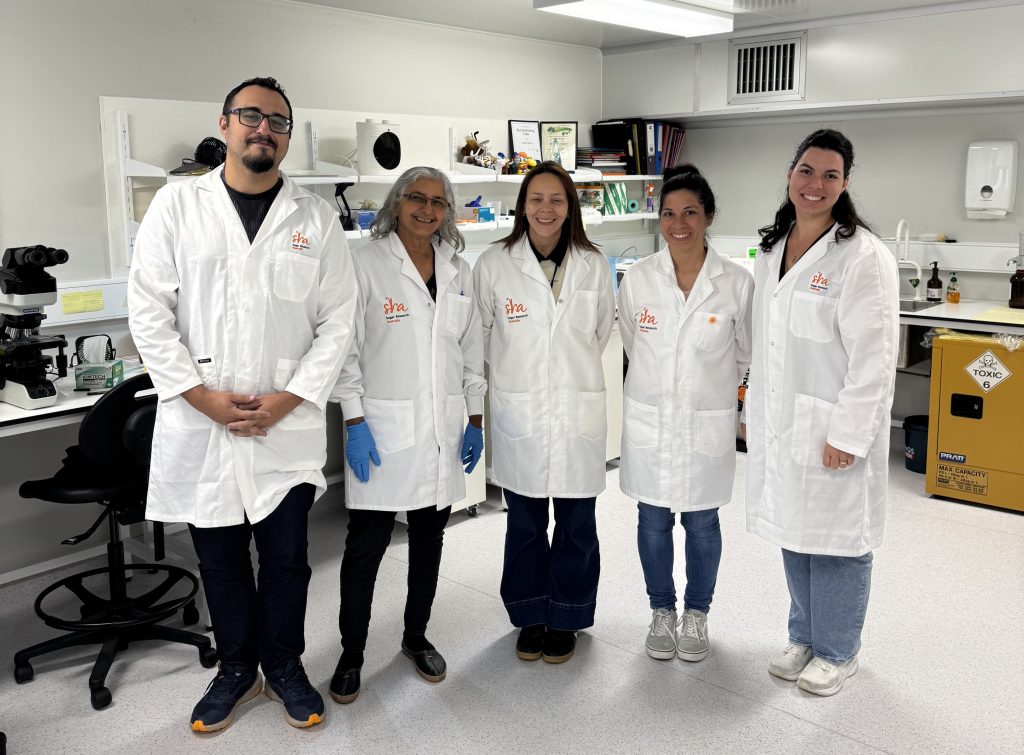
A project fully funded by the Department of Primary Industries (DPI), managed by SRA and led by Leader Biotechnology Dr Nathalie Piperidis (above, centre), is applying advanced genetic techniques to the problem, with SRA Research Fellow Katherine Pinto Irish (above, second from right) and SRA nematode expert Dr Pedro Confort (above, left) undertaking the first steps.
Ms Pinto Irish is studying how nematodes attack sugarcane roots and why varieties such as Q208 resist subsequent disease and maintain yield, even with nematodes living and multiplying in them, while other cultivars are susceptible.
In a controlled laboratory study, Ms Pinto Irish tracked penetration of the nematodes into the roots of both resistant and susceptible cultivars as early as 12 hours after inoculation. Rather than preventing entry, the plants’ resistance to the nematodes seems to depend on a response after infection by the parasites.
What’s been done to date?
Clones from the wild sugarcane species Saccharum spontaneum have been screened in SRA trials to identify strong natural nematode resistance (Shamsul Bhuiyan et al., 2019).
SRA researchers led by Variety Development Manager Dr Fengduo Hu have transferred these naturally occurring resistance genes into elite, high-yielding cultivars through a process called introgression, using conventional breeding practices. This population, developed over five years, is now being used for genetic study.
Here’s what we know
- Parasitic nematodes enter roots, feed and reproduce, damaging tissue and reducing water and nutrient uptake.
- Sugarcane can detect invading nematodes and activate immune responses, but nematodes may release effectors that suppress those defences in susceptible varieties.
- Cultivars with resistance genes can trigger stronger defences; without them, nematodes multiply and weaken the plant.
- Tracking these interactions helps researchers time root sampling for detailed analysis of sugarcane defence mechanisms at the genetic level.
Next steps for breeding
The next step is to identify resistance-related genes from Saccharum spontaneum, a wild ancestor of modern sugarcane known for resilience to multiple stresses. Researchers are comparing roots from resistant and susceptible inoculated cultivars using a new genetic method called spatial transcriptomic analysis to identify the genes and pathways involved in natural resistance. This method shows where gene expression occurs across root tissues, including vascular bundles and the outer layer below the plant’s ‘skin’.
“Cane growers can get excited about these new methods, which we hope will overcome research challenges linked to sugarcane’s highly complex genetic structure,” Dr Piperidis said.
The work could improve parent selection and support development of nematode-resistant varieties, giving growers more resilient crops and improving industry productivity and sustainability.
“I thank the collaborative project team and the DPI for its generous funding,” Dr Piperidis said.
SRA researchers:
- Research Fellow in Bioinformatics, Katherine Pinto Irish
- Manager Biosecurity & Disease Screening, Dr Shamsul Bhuiyan
- Senior Pathology Technician, Kylie Sherring
- Lead Field Pathologist, Dr Seona Casonato.
- Research Fellow, Dr Pedro Confort
and at The University of Queensland:
- Senior Principal Research Fellow, Dr Karen Aitken.
(Above): The SRA team working on improved nematode management in sugarcane.
Acknowledgement
This project is fully funded by the Department of Primary Industries and managed by Sugar Research Australia.