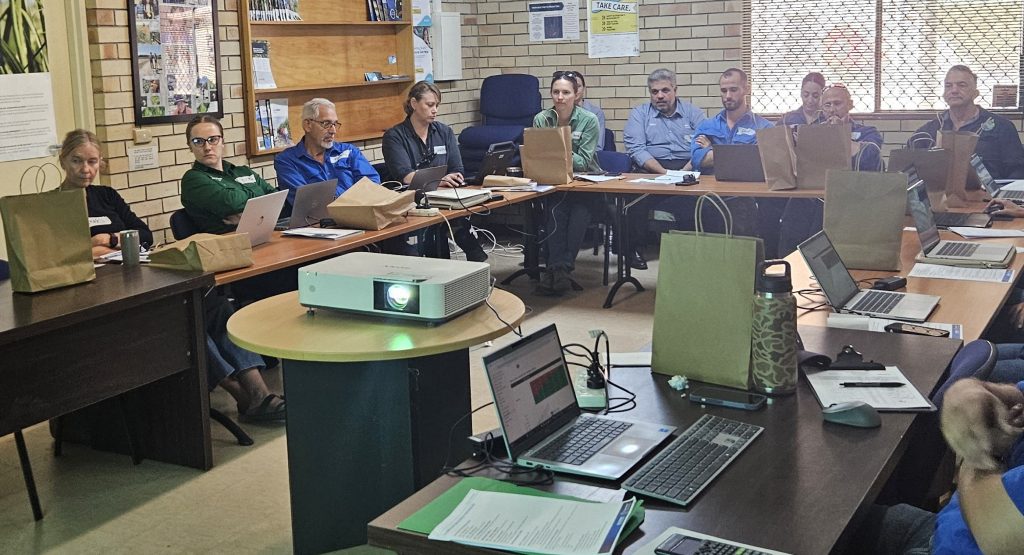
There was standing room only at a workshop about a tool called FEAT on 7 May at SRA Burdekin Station when growers, resellers, consultants and extension staff gathered to learn more about how this tool can help their business.
The Farm Economic Analysis Tool (FEAT) Online is a free farm management tool for sugarcane growers. It makes data entry easy to help growers better understand projected outcomes for different farming scenarios before a practice change is implemented.
It is easily accessible on phone, tablet or computer. Although a computer is the preferred option.
SRA has supported the development of this tool and collaborated with DPI through its initial appearance as a spreadsheet to an online tool today, ensuring it fits growers’ purposes in different canegrowing regions.
The workshop was planned as part of this year’s Burdekin District Productivity Plan and with 18 people in the room, it was the largest workshop held on FEAT to date.
District Manager Terry Granshaw said the tool and the workshops were included as part of the productivity plan to allow growers to understand their own cost of production based on their own practices and compare costs when implementing other practices before actually doing the activity.
Participants listened to DPI NQ (Townsville) Agricultural Economist Edward Vaggelas, QRIDA Regional Area Manager Angelo Ragano and Farm Business Planning North Qld Program [Link] Lead Natalie Hughes.
The program kicked off with Ed demonstrating the current online FEAT program, its regional files and fallow crop options. Next, Angelo spoke about current grant options available to Burdekin growers, including the extension of the Exceptional Disaster Assistance Recovery Grant until 14 August this year.
One of the growers shared their experience about the amount of time it takes from the start of an application to receiving grant funds saying the process was detailed and took time but was worth the effort. Terry asked Angelo if a simple flow chart could be developed to guide growers through the process from providing information and financials in an application to the time when works are completed and grant payments arrive.
Natalie Hughes spoke about growers contacting the Farm Business Planning team who can help them to create a detailed farm plan free of charge. Terry explained that these plans provide growers with the opportunity to apply for a range of grants including a Drought Preparedness Grant which enables them to upgrade their current infrastructure to mitigate future drought events and purchase new technology to reduce energy consumption and water usage. They are also useful when applying for a bank loan.
Participants then got the opportunity to create their own FEAT file and update some of the data in the files to current prices. Ed assisted by updating the Soybean and Mungbean files with the latest prices. He provided two different scenarios to give growers the chance to compare different practices and observe the financial outcomes.
“Current fertiliser and fuel prices have made a significant impact to industry stakeholders’ cost of production,” Terry Granshaw said. “The FEAT tool allows growers to see the impact of these changes firsthand and change scenarios in their own time to better understand projected outcomes before a practice change has been implemented.” He encouraged growers to take a look at the FEAT tool which can be downloaded here: He thanked the presenters for taking the time to put together the presentations which were very well received by participants.