In the 2025 season, a prototype electronic cane bin tracking system known as BinSites began kicking goals with the successful development and testing of:
- A harvester app to consign cane
- A loco app to identify cane bins being dropped off and collected; and
- A bin number reader.
BinSites has been developed by the Queensland University of Technology (QUT) and partner, software and information technology developers, iScape, in the past year. The project is wholly funded by the Department of Primary Industries and managed by SRA with in-kind contributions from several mills. The project is now working on developing and testing a mill computer portal for the management of the system.
“Mills have shown a lot of interest in the system and this year we are working with MSF Sugar (Tableland Mill), Bundaberg Sugar (Millaquin Mill) and Tully Sugar (Tully Mill) to test the system within their own environments,” Chief Investigator, QUT’s Associate Professor Geoff Kent said.
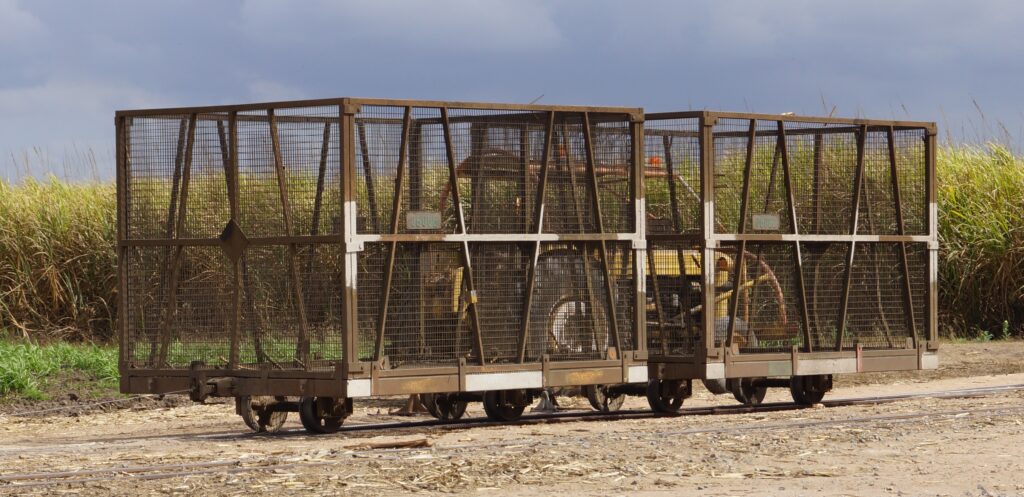
Geoff Kent commented that growers would benefit, too, from an electronic consignment note allocating a cane bin to a grower, reducing human errors by doing away with paper consignment notes where there was a risk of incorrectly transcribing data or the notes being lost completely. The project is focusing on accurate bin number reading and using bin number readers, loco crews and harvester crews to provide data to the system electronically, eliminating the use of paper records and data double-handling. The system aims to provide real time tracking of all cane bins in a cane railway network, providing their location and whether they are empty or full. Full bins will also contain consignment information identifying the block from which the cane was harvested and the time of harvest.
This will provide:
- the traffic office with better information for scheduling decisions and more time to focus on the safe operation of the cane railway
- better information for harvesters about upcoming cane bin deliveries for improved planning
- advanced notice on the cane supply to the mill
- earlier information for growers about the status of their harvest for the day.
Greater visibility is expected to bring greater accuracy of cane consignment, Geoff Kent said.
“To ensure the correct grower is paid for their cane, sugarcane ownership is currently documented on paper when it is loaded into the cane bin. Traditionally, a harvesting crew member completes a paper consignment note which allocates the bin to a grower. The consignment note is left for the cane transport crew to collect. At the mill the cane transport crew provides the consignment note to the weighbridge clerk who enters it into the weighbridge computer. While every effort is made to ensure accuracy, there are problems if:
- Incorrect information has been written on the consignment note
- The consignment note is lost in transit
- The consignment details are incorrectly transcribed at the mill.
- In addition, the mill has no knowledge of the harvested cane until it reaches the mill.
“For most factories where road-based cane transport operates, the consignment system has already been largely automated, with cane electronically consigned in the field. The road transport scheduling is also automated, in a system supported by Agtrix, an Australian company which supplies supply chain logistics software. Isis Mill, supported by Mirrabooka Systems, Australian software developers, has an electronic consignment system for its rail-based transport system. Isis Sugar’s initial deployment experience will be shared with other millers. Isis has seen substantial benefits with their system but further improvements are warranted, particularly the need to reduce time and effort in identifying correct bin numbers in the field.
“The remaining five milling companies owning 15 factories which operate rail-based cane transport systems all want the profitability and productivity benefits of electronic consignment. These mills have found off-the-shelf solutions to be unsuitable and so they have committed to designing a shared solution. The savings are estimated at between $100,000 to $200,000 at each mill per year.”
Of the five milling companies, three wish to adopt electronic consignment within two years while the other two have prioritised adoption in their five-year plans. The expected outputs of this project are:
- The prototype bin number reader, which consists of a camera, processor, networking, supporting software and documentation
- The prototype software system BinSites consisting of the database, the mill portal, the loco app, the harvester app, the API and documentation, ready for factory testing
- Recommended design of the bin number reader, ready for implementation at any site
- Knowledge gained by the mills from trialling the system
- A stable software system implemented or ready for implementation at the remaining milling companies.
Some milling companies are expected to implement the developed software system within the scope of this project. The remaining companies are expected to implement the system within five years of the project’s completion.

This project is fully funded by the Department of Primary Industries and managed by SRA