A project which aims to develop pest management strategies to control exotic moth borers through Conservation Biological Control (CBC) has been announced by the ARC Training Centre in Plant Biosecurity. SRA is a Partner Organisation.
Appointed to this project is Viviana Aya Vargas, a PhD student based at James Cook University and SRA Meringa. Her supervisors and advisors are Dr Emtia Chandrima and Dr Kevin Powell at SRA, Dr Myles Menz and Prof. Lori Lach at James Cook University.
Viviana is a biologist with more than eight years’ experience working in insect biology, molecular techniques and sustainable pest management. Her research experience in Colombia has strengthened her interest in integrating insect-plant interactions and developing innovative biological control approaches.
“Through my PhD research in the ARC Training Centre in Plant Biosecurity, I aim to contribute to the sustainability and health of sugarcane crops by investigating how conservation biological control can strengthen native natural enemies. This project allows me to combine my background in entomology, microbiology, and crop protection to support more resilient and environmentally responsible agriculture,” Viviana said.
What is CBC?
Conservation Biological Control (CBC) involves the promotion and management of native natural enemy populations, such as predators and parasitoids, to control pest species, with the goal of reducing the use of pesticides in natural and agricultural systems.
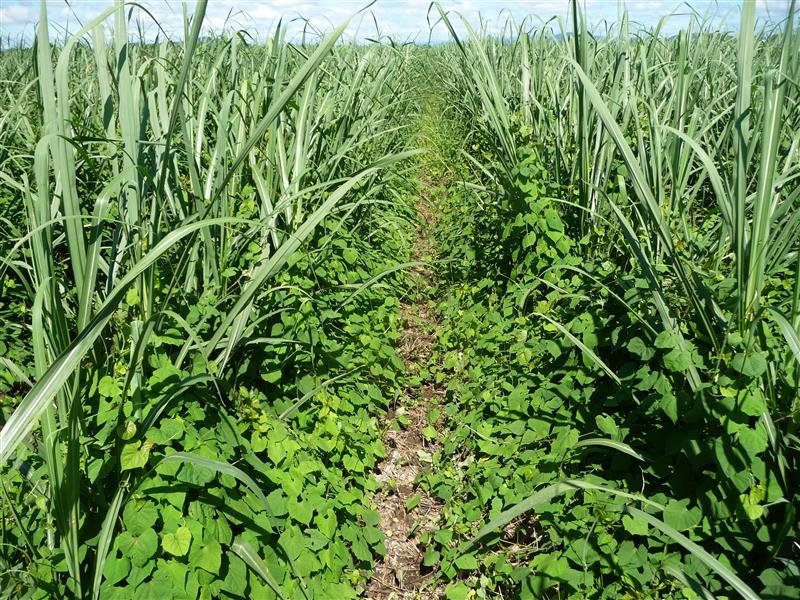
Populations of natural enemies can be increased by the provision of suitable habitat with plant-based food resources (pollen, nectar, extrafloral nectaries) or alternative hosts for both pests and natural enemies (source or sink, host ranges and overwintering sites).
Why target moth borers?
Moth borers are major pests of sugarcane in many sugar producing countries that are difficult to control and cause substantial damage to crops through reduction in both biomass and sugar content.
Although Australia only has one endemic moth borer species (a minor pest) affecting sugarcane, a further 37 more destructive major pest species occur in neighbouring cane growing countries. The moth borer species complex has been reported to cause up to 70% yield loss in sugarcane growing regions of countries neighbouring Australia such as Indonesia and PNG, and have been identified as a high priority biosecurity threat for the Australian sugarcane industry.
In the case of exotic moth borers, chemical insecticides would only provide short term rapid management as part of an early incursion plan, but it leaves a long-lasting problem including the potential for pest resurgence, insecticide resistance, detrimental environmental impacts on wildlife, natural enemies, waterways, and health of growers.
This project is focused on CBC-based Integrated Pest Management, which is a sustainable management approach that includes conservation and enhancement of existing native natural enemies in local habitats.
CBC-based IPM of sugarcane will ultimately reduce the use of broad-spectrum insecticides resulting in more balanced natural ecosystem with functional natural enemies. This is an economically feasible, environmentally friendly sustainable post-incursion management approach which will provide safe hub for natural enemies of moth borers and other pest insects.
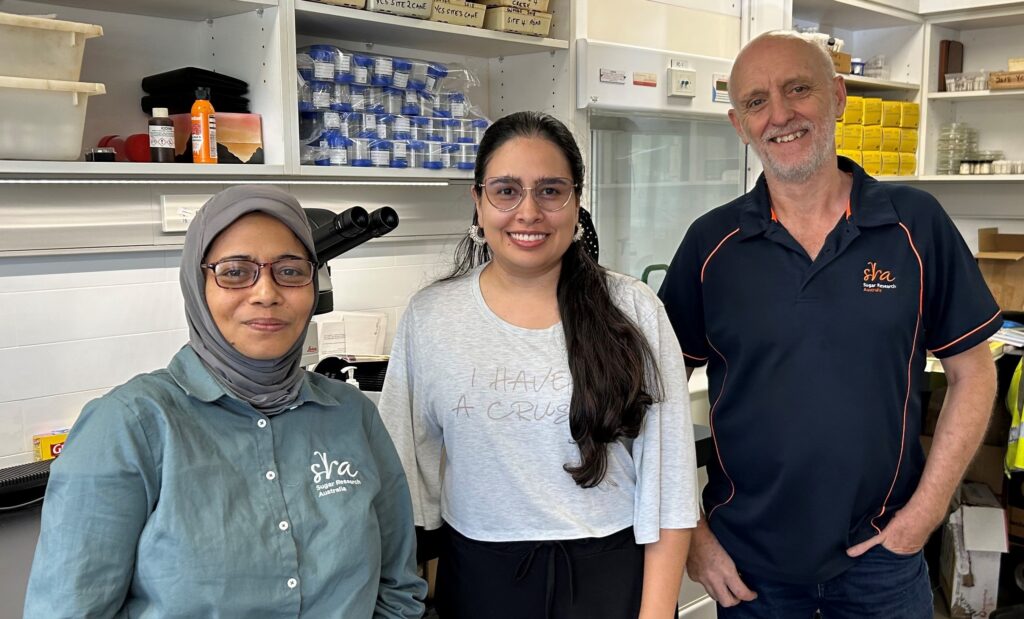
(Above): SRA Entomologist Dr Emtia Chandrima (l) and Entomology Leader Dr Kevin Powell welcome PhD student, Viviana Aya Vargas, to SRA Meringa.
(This article was originally published in the newsletter of ARC Training Centre in Plant Biosecurity and has had minor edits.)