
Central district growers are interested in the different root systems in sugarcane varieties and their implications for management. Senior Variety Development Manager George Piperidis recently attended a presentation on the assessment of sugarcane root systems.1 This was the starting point for SRA Central’s proof-of-concept demonstration for growers, focused on analysing sugarcane root systems in Australia.
SRA Central is now seeking growers’ feedback on the demonstration which is part of the current District Productivity Plan. The aim is to gather and share growers’ experiences with established varieties.These may provide important insights into managing new varieties that have similar root systems characteristics.
Details of the analysis of sugarcane root systems
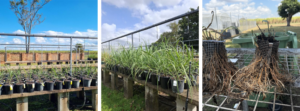
On 27 June 2025, 15 sugarcane varieties were collected from SRA plots within the Central district. These included five established varieties, five recently released varieties, and five promising clones. From each variety, a single stalk was selected and cut into single-eye setts. The setts were placed into 30-cell trays, filled with potting mix, watered, and transferred to a germination room maintained at 31 °C to optimise germination rates.
After six days, on 3 July, the trays were removed from the germination room. Multiple setts displayed visible signs of germination, indicating readiness for transplanting. Six of the best single-eye setts from each variety were selected and transplanted into mesh cylinders at a depth of 35mm. The cylinders measured 90mm in diameter and 150mm in height. Each cylinder was positioned centrally within a medium-sized plastic pot and filled with potting mix. Upon completion, a total of 90 (15 varieties x six repeats) pots were arranged in a randomised layout on concrete benches under an overhead sprinkler irrigation system.
To determine an appropriate irrigation schedule, a test was conducted prior to transplanting. Five medium-sized pots filled with potting mix were positioned on the benches, one at each corner and one centrally. The five pots were then monitored over a two-day period for the depth of water penetration and uniformity. Based on these observations, an irrigation schedule of five minutes twice daily was selected, which occurred at 8:30am and 4:00pm.
The pots were monitored over a 90-day period, during which observational data was recorded. On day 60, it was observed that the pots were receiving different amounts of irrigation due to high system demand, wind interference and increased sugarcane canopy. The irrigation duration was increased to ten minutes twice daily in an attempt to minimise variability. In future demonstrations an alternative system will be used, such as individual drippers.
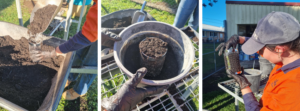
At the conclusion of the trial on day 90 (25 September), the mesh cylinders were removed from the pots and divided vertically into six sections, labelled A to F. Each section represented a different root angle fraction, following the same process as Terajima et al (2024).
Once the number of roots in each section were counted, an internationally recognised method was used to calculate the Root Growth Angle Index (RGAI). RGAI was used by Terajima et al (2024). to determine the dominant angle that the roots distribute themselves. This provides an understanding of the natural growth angles inherent in different sugarcane varieties’ root systems.
Higher RGAI values are associated with more vertical root distribution, indicating a greater proportion of roots established lower in the soil profile. Data were collected from all 90 pots and analysed; however, no statistical differences were identified between varieties, largely due to the amount of variability induced by the irrigation system. Nevertheless, there were still clear trends identified between the varieties e.g. the total number of roots and the number of roots per angle fraction.
The demonstrations
In late 2025, the results from this proof-of-concept demonstration were presented to growers and advisors in the Central district during three sessions: Proserpine, Te Kowai and Carmila. Throughout these sessions, attendees provided insights about the management of each variety while discussing the results. The root growth trends of each variety served as a proof of concept and supported observations made in the field by growers.
While there was no correlation between RGAI and the management/adoption of varieties, the number of roots, in particular angle fractions, are potentially a better indicator for management strategies and overall adoption.
Overall feedback from growers and advisors was supportive of continuing this work, with a desire to provide SRA with further observations on management of varieties.
Requesting Feedback from Central growers
Central growers have been emailed this link from SRA this week to provide their feedback on variety management from their own experiences.
Central growers can provide their feedback here:
Sugarcane Variety Root System Survey
For further information please contact SRA Central District Delivery Officer Hayley Keats on 0448 085 196 or hkeats@sugarresearch.com.au
(Above: SRA District Delivery Officers Hayley Keats and Emma Burns worked together on the sugarcane root systems project.)
Acknowledgement
- Terajima, Y. et al., 2024. Root characteristics of intergeneric hybrids between Saccharum spp. hybrid and Erianthus arundinaceus.. Coimbatore, India, International Society of Sugar Cane Technologists.