A list of all known exotic and established pests of sugarcane and their potential biosecurity threat to sugarcane production is available in the newly revised Biosecurity Plan (2024-2029) for the Sugarcane Industry. The Plan was recently released by Plant Health Australia (PHA), the not-for-profit coordinator of Australia’s plant biosecurity system, which was established in 2000 to protect agriculture from pests and diseases. The original biosecurity plan was released in 2004 with updates in 2009 and 2016. The new version has been formally endorsed by the industry.
Of the 475 pests of sugarcane described in the scientific literature, 29 or about 6%, have been identified as High Priority Pests (Page 11) and 20 or about 4% have been identified as Exotic Pests to Monitor (Page 23). The High Priority Pests (HPPs) are covered under nationally agreed arrangements in the Emergency Plant Pest Response Deed (EPPRD). Exotic weeds are not included. Other existing, endemic pests of biosecurity significance already in the industry are also identified (Page 32) where they are considered economically important and either currently under quarantine arrangements or notifiable by law with market access implications which growers must manage through farm biosecurity practices.
Elisa Westmore, Manager, Environment and Sustainability, CANEGROWERS, said that the revised plan was an important step forward, not only in raising awareness about the industry’s most damaging threats, but also in developing a plan to actively minimise the risks posted by exotic pests and to respond effectively if an incursion does occur.
“The work on the plan was co-ordinated by Plant Health Australia with representatives from CANEGROWERS, Sugar Research Australia, the Australian Sugar Milling Council, relevant state and territory agencies representing plant health, biosecurity experts and other industry representative. CANEGROWERS as the peak industry body for the Australian sugar industry is a signatory to the Emergency Plant Pest Response Deed (EPPRD). This agreement between the Australian Government, state/territory governments and Plant Health Australia is a legally binding document that outlines the principles and guidelines for Emergency Plant Pest (EPP) incursion responses, including an agreed structure for sharing costs to deliver eradication.
“Sugar Research Australia has played a key role in revising the Plan by identifying and documenting the industry’s exotic pest threats. The team included Biosecurity and Pest Screening Manager, Dr Shamsul Bhuiyan, Research Mission Manager, Dr Stephen Mudge, Lead Field Pathologist Dr Seona Casonato, Lead Entomologist, Dr Kevin Powell and Molecular Plant Pathologist Dr Chuong Ngo.”
SRA Research Mission Manager Dr Stephen Mudge said that the biosecurity plan is designed to address the strengths and weaknesses of the industry’s current biosecurity arrangements to improve capacity. The list of HPPs will also guide future R&D investment in biosecurity.
“An Action Plan (Page 4) details strategies required for:
- Preparedness and Response
- Capacity and Capability
- Communication and engagement
- Innovation, Research, Development and Extension
- Collaboration and partnerships.
“Current and planned future activities by CANEGROWERS, Australian Sugar Milling Council, Sugar Research Australia, productivity services companies, Plant Health Australia, government and other stakeholders are detailed in these strategies. The current level of preparedness for high priority pests has also been documented (Page 49) in terms of National Diagnostic Protocols and contingency plans; current activities being undertaken such as surveillance; and the potential collaborators in other agricultural industries who could be call on in an incursion.”
A summary of activities (Page 62) already undertaken to mitigate the impact of pest threats and for managing risks at all operational levels is provided. These include:
- Government and industry-wide risk mitigation e.g. quarantine legislation
- Training and awareness raising, research and quality assurance e.g. biosecurity inclusion in BMP programs
- Pest management and farm hygiene e.g. control of vectors
- Equipment and vehicle management e.g. wash down facilities
- People and product management e.g. using clean seed and resistant varieties.
The processes in place to respond to emergency plant pest incursions are summarised, including the Emergency Plant Pest Response Deed and Biosecurity Incident Standard Operating Procedures (BISOP).
“The Farm Biosecurity Manual, first released in 2017, is currently being revised for sugarcane growers to raise awareness and preparedness on farm for key biosecurity risks for the industry. It is expected to be released early next year,” Dr Mudge said.
The Biosecurity Plan for the Sugarcane Industry can be read here.
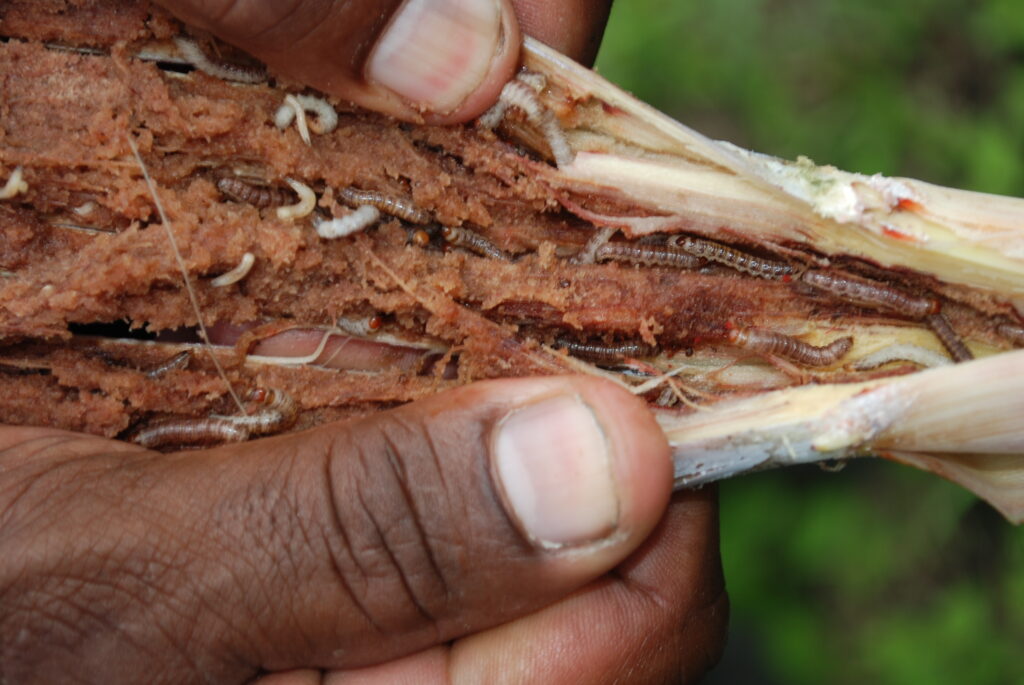
The image above shows exotic stemborer damage in Papua New Guinea. The larvae is from one of the Sesamia family, not yet found in Australia. There are a number of references to the impact of this insect in sugarcane in the Biosecurity Plan.