At a workshop in October, sugar milling personnel heard the results of a mill survey investigating how the sector is reducing exposure to lead fumes and dust, and welding and cutting fumes, and what other methods are available.
The project is a Small Milling Research Project funded by SRA in response to updated safety regulations in the current Sugar Mill Safety Code of Practice 2024.
The methods discussed may also interest sugarcane growers who maintain farm machinery on farm using welding and other practices that generate hazardous fumes and dust.
Nineteen sugar factories have been surveyed, and their representatives were at the workshop, which was run by Chief Investigators, QUT’s Associate Professor Geoff Kent and Senior Research Fellow Floren Plaza. By collecting and sharing data about how different milling sites are mitigating risks, the project aims to assist each milling company to determine the most effective approaches.
Lead fumes and dust arise from operations conducted on leaded bronze mill bearings including welding, machining, grinding and buffing. Engineering company, Bundaberg Walkers has been trialling lead free bearings with some mills. Some sites are minimising the amount of grinding they do to reduce dust.
Bearing grinding must be done well away from other workers. Some sites use barricades to reduce access to the site where grinding is proceeding. Consolidated Plastics is working with some mills to construct new rooms. One mill has bearing grinding booths connected to a fume extraction system in three rooms. Some use water sprays on the walls to form a curtain to keep the dust in. Some sites have their brass grinding set up in an open area for good ventilation while others use fans to extract air. Vacuum cleaners are recommended to capture the dust for safe disposal.
Fume generation from welding is an area of general concern. The sites have recognised that the boiler maker is protected by Powered Air Purifying Respirators (PAPR) and it is the passive risk to surrounding workers that must be controlled. Some mills are reducing the need for roll arcing during the season by using long life surfaces for the roll surface. This enables the surface coating application to be transferred from the factory to the workshop where welding can be better controlled.
Some mills are looking at using less harmful welding consumables. Some sites select sticks or wires for roll arcing during the crushing to lessen fume generation.
To capture fumes, different approaches are used, particularly in the workshop. Mobile units from Lincoln Electric are being used at two mills and these have a self-cleaning option using compressed air. A similar system is used in another mill to capture some of the fumes when arcing takes place on feed and delivery rolls. At two sites, KEMPER welding fume extraction equipment is used. At one of those sites, a frame has been built around the KEMPER equipment so it can be easily lifted up to the top of the mill or moved from mill to mill.
The main issue with fume extraction is getting the fumes to go up the equipment’s ‘snorkel’. The shape of the pickup hood is critical. Mills have been experimenting with the best shapes. The mills agreed the boilermaker has to move the fume extraction equipment across the roller as he works on it because the fumes are only collected when the hood is sitting over them. The use of fans while roll arcing can also cause a problem when the fumes are blown away from the hood and not captured. Once the fume is successfully captured it is put through a filter which must be cleaned regularly.
More commonly in mills the breeze is used to take the fume away from workers. In some cases, a fan blows fumes away from the worker and many mill buildings, workshops and work sites are quite open, allowing the breeze to dilute the fumes and carry them away. In one mill, the top doors above the feed chutes are opened on maintenance days and the natural updraft takes the fume up through the feed chute.
Many sites have built in extraction systems consisting of fans, flexible housing and piping. However, they can block up with fibres during the crushing requiring regular cleaning. At one mill, there is a hood above the top roller to capture fumes. Many sites have chimneys to expel the fume outside the mill building. However, on still, wet or humid days some of the fume can find its way back down.
One mill has trialled extraction which is fixed to a MIG gun at the point of fume generation. There are a few new systems like this mentioned in the Code of Practice – some are a separate hose and clip-on arrangement to capture the fume. AWS is one of the companies offering it.
One mill uses extraction fans on the mill building roof which work well during both crushing and maintenance, even on still days. Another mill’s welding workshop is open at both ends and at the top on both sides. Fume extraction systems exist on both sides and whirly birds have been placed on the roof. Another uses large portable fans that are lifted to the top of the mill on maintenance days to help extract fumes towards the top of the building.
Where automated welding equipment is used, an operator can stand away from the welding site and monitor what’s going on around the welding equipment, including the position of other workers and where the fume is going.
At other mills barricades prevent workers accessing welding sites entirely until the operation is finished. At another, arcing is done on the weekends when the operational staff are not around.
Environmental monitoring consultants have recommended:
- Investigating the on gun welding fume extraction system for effectively capturing rather than emitting fumes.
- The PAPR type of respirator as a better choice to fit all welders.
- Workers in the vicinity of roll arcing should be wearing P2 respirators but these only function to about 10 times the exposure limit. For higher fume exposure more advanced respirators are needed.
- Hands should be washed when leaving the work area.
- Worker health should be monitored annually.
- Safe work procedures or work instructions should cover all requirements of the Code of Practice and define the PPE that should be used.
A final report is being prepared for circulation to the mills.
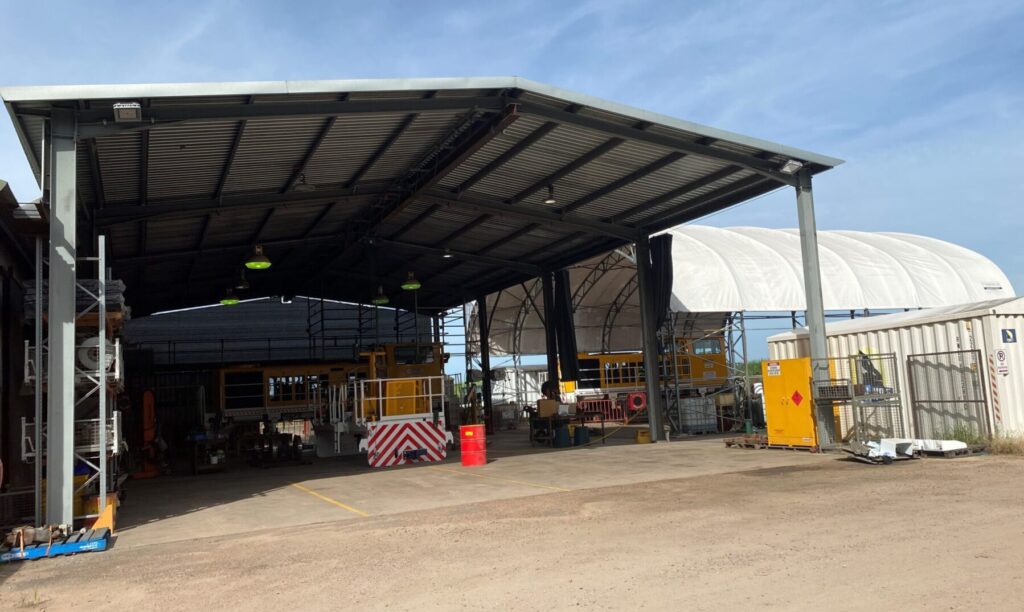
(Above): locomotive shed at a NQ sugar mill.