Two SRA-funded research projects are currently investigating new options for Greyback canegrub control.
Project 2025-001 – Beyond imidacloprid – Ensuring effective and sustainable canegrub control for the future has established field trials to look for alternatives to imidacloprid for effective canegrub management.
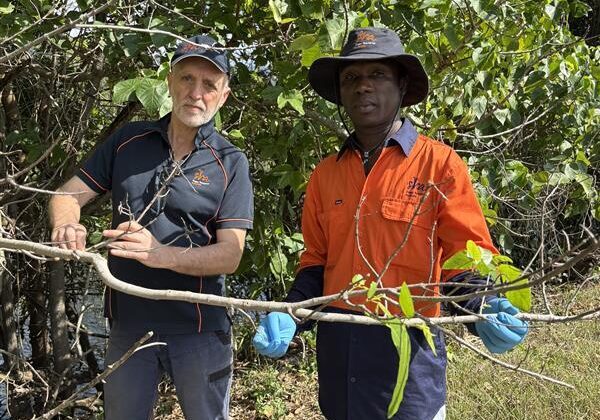
Another project, 2024/402, is concentrating on the adult life-stage of the pest. Entomology Research Scientist, Dr Samuel Bawa (above right, with SRA Lead Entomologist, Dr Kevin Powell), has undertaken a 12-month study to identify volatile compounds present in host plants, which naturally attract adult cane beetles.
“Most of the trial work we have done in the past and continue to do in canegrub management has targeted the canegrub larvae, through testing different chemical and biological insecticide products,” Dr Bawa explained.
“But what we are trying to do in this project is to target a different part of the life-cycle – the adult cane beetles – and identify the volatiles present in the host plants which attract the adult beetles, where they feed and breed on these plants.”
Examples include sandpaper fig, strangler fig, ornamental fig and jackfruit trees. A volatile is a naturally occurring, organic chemical found in host plants and released through different parts of the plants, such as the leaves, roots and stem, attracting the pest. If volatiles from host plants can be identified, Dr Bawa said it would ultimately open the way for the development of a natural alternative to existing chemical management techniques.
“The first stage of this pilot project is to identify the host plant’s volatile profile. Once we obtain that, the next stage would be to conduct behavioural bioassays in the laboratory to identify the most attractive volatile organic compound that could lead to developing a synthetic product that mimics the volatile compound,” Dr Bawa said.
“In nature, when adult cane beetles emerge from the soil, they will identify a host plant that they will feed and breed on. After that, the beetle will lay their eggs in the soil next to the cane, and when hatched, the larvae will dig down and start attacking the sugarcane roots.
Ït’s not the adult beetles that feed off the roots of the cane, it’s the larvae. So, if we can develop a synthetic compound that attracts the cane beetle in the same way as the host plant, we can use this to eventually develop a commercial product to use in traps, to trap the cane beetles, before they have a chance to lay their eggs in the soil.”
Dr Bawa began his project in December 2024 and is working in collaboration with the University of New England throughout the trial.
If he is successful in identifying the volatiles which attract the adult beetle, it could potentially lead to either a significant shift away from existing chemical management or be incorporated in an integrated approach to target both adults and larvae.
Project 2024-402 – The Sweet Smell of Success – Sustainable Canegrub Management using Host Plant Volatiles is funded by Sugar Research Australia and is being run in conjunction with the University of New England (UNE).
(This article originally appeared in Cane Matters magazine, Summer 2024/25 on page 13.)
Register now for the upcoming SRA webinar: https://sugarresearch.com.au/webinars