
Would sugarcane tonnage and yield increase markedly on your farm if there was an accurate, time efficient and inexpensive way to replant the gaps that can develop in the rows of your ratoon crops?
A new project funded by SRA under the Sugar Industry Postgraduate Research Scholarships (SPRS) scheme is focused on how to replant gaps in cane rows using modern technology. The researcher, Bruen Smith, who is studying for a PhD at the University of Southern Queensland, is focused on solving the problem of a decline in sugarcane yield after the initial harvest of the plant crop. The development of gaps in the ratoon crop can be because of factors such as diseases, pests and soil compaction.
“Ratoon crops are economically efficient since they avoid the cost of planting, the most expensive operation in sugarcane production estimated at $800 per hectare (in 2014),” Bruen said. “In addition, research has shown significantly less soil erosion and nutrient loss in ratoon crops. Their pre-established root systems mean accelerated growth, early maturity and reduced production costs compared with plant crops. In Australia the typical number of cycles includes a plant crop and three ratoon crops in most districts. A primary factor contributing to yield decline in ratoon crops is the formation of on-row gaps and soil compaction caused by agricultural machinery.”
Both direct and indirect losses are associated with in-row gaps, Bruen found. Direct losses refer to the sugar that would have been produced by the missing cane while indirect losses include the cost of additional maintenance needed because of the gap. Bruen’s literature review revealed that technologies have already been developed to detect gaps in the sugarcane stand but no technology yet exists to automate the localised replanting of these gaps. New machines such as Unmanned Aerial Vehicles (drones) and the XAG R150 Agricultural Unmanned Vehicle (such as the XAG R150), to name just two, are already on the market as an alternative way to solve agricultural challenges.
“For successful gap filling three main factors need to be identified: the gap density threshold, the timing and the type of propagule,” Bruen said. “Some researchers argue the cane stand can compensate for in-row gaps less than 0.8m in length while in-row gaps exceeding 20% can cause considerable yield losses. Others say that fields with in-row gaps exceeding 50% should be either ploughed out and replanted or fallowed. However, no empirical research backs these statements.”
Still others say there is 3.2% yield reduction for each 10% increase in gaps based on a 0.5 m in-row gap. However, these figures are based on a single study from the 1980s, and their relevance to current farming systems and crop varieties is uncertain. Further research is needed to validate and build upon this work. In-row gaps also need to be repaired because breaks in the canopy enable weeds to establish in the cane stand. Their seeds lead to increased weed infestations in subsequent years. If the gaps are neglected, weed populations will eventually proliferate, reducing yields and hosting diseases and insects.
“Some growers I’ve talked to point out the role of harvesting in increasing the length and extension of gaps due to the harvesters’ base cutters interacting with pre-existing gaps,” Bruen said. “What if replanting equipment could be designed that could plant gaps without worsening compaction? Drones are now commonly used in remote sensing applications and in-row gap mapping may be another useful function they could perform. This could facilitate localised replanting of in-row gaps when technology is developed to perform this function.”
The aim of the project is to develop an autonomous mechanised system to conduct localised in-crop replanting of gaps. The project aims to:
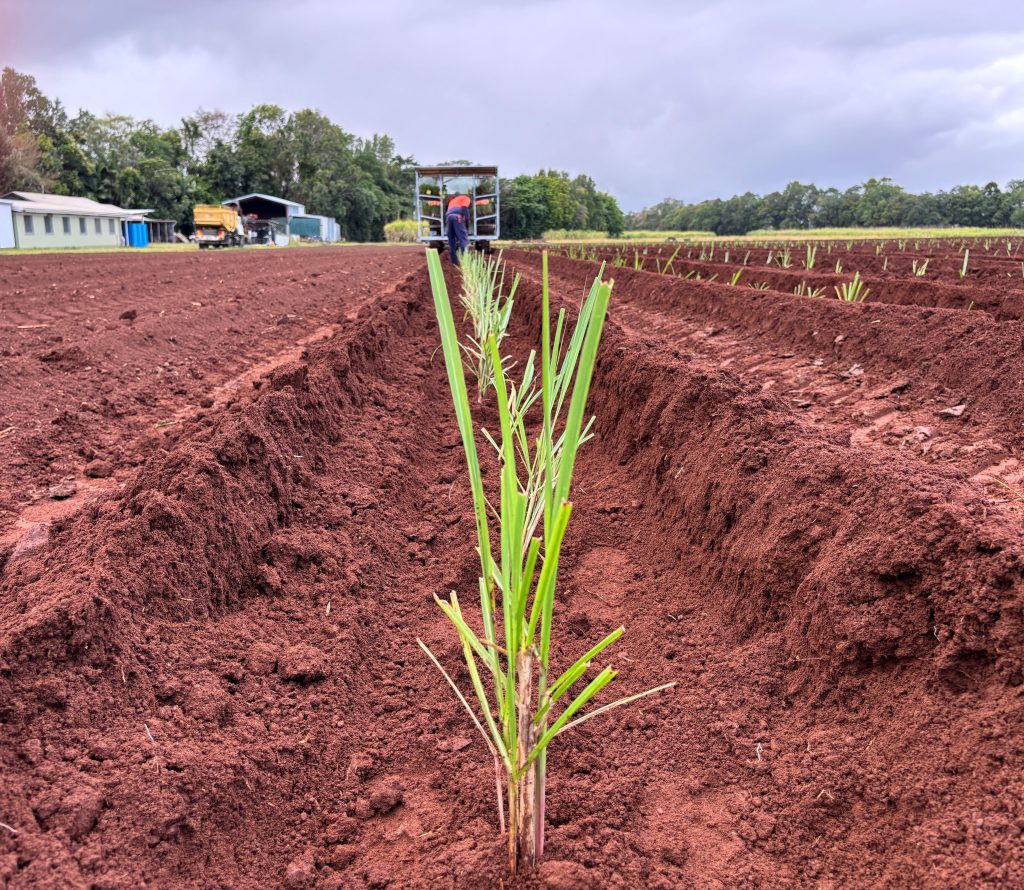
- Develop a novel software support system to guide a small ground-based autonomous device to conduct localised replanting of sugarcane based on prescription maps.
- Develop a novel ground-based autonomous small mechanised device to conduct localised in-crop replanting of gaps in sugarcane.
- Evaluate the developed system in a commercial field to understand yield and profitability of the system.
- Evaluate the effects of using the developed system on the health of the sugarcane stand.
- A cost-benefit analysis of adopting the proposed system.
“The project is currently focused on developing the automated planting system. Trials will guide the refinement of a fully automated prototype, which is scheduled for field evaluation in the next phase of the project,” Bruen said.
The Sugar Industry Postgraduate Research Scholarships (SPRS) enable qualified graduates to undertake Research Doctorate or Research Masters study and to facilitate research and training in areas of value to the Australian sugarcane industry. The scholarships are tenable at Australian universities and institutions for postgraduate research study.