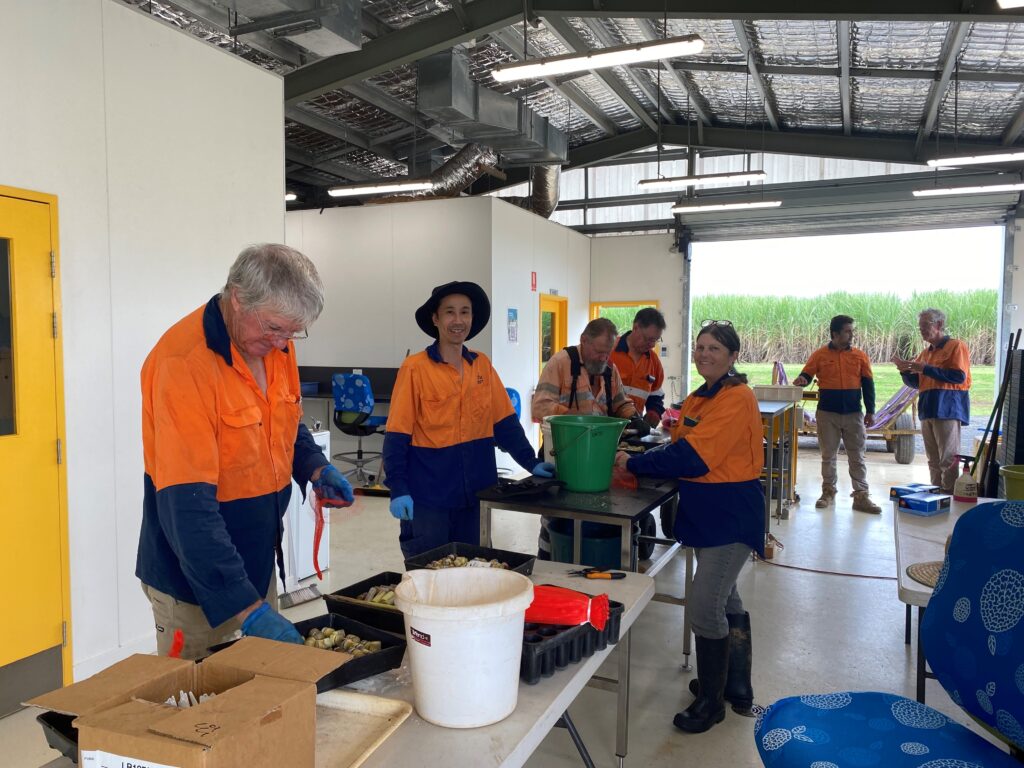
A Bundaberg team of workers (top, l to r: Peter Hansen, Chuong Ngo, David Goodall, Darren Browne, Liz Wilson, Sanjaya Timilsina, and Roy Parfitt) were cutting one-eye setts (OES) on the Station last week. Numerous stalks of cane from several selected clones were collected by Variety Officer Sanjaya Timilsina and his team in the week prior to our visit.
The stalks undertook a Cold Soak Long Hot Water Treatment (CSLHWT) prior to one-eye setts (OES) cutting. Molecular Plant Pathologist Dr Chuong Ngo and Senior Quarantine Technician Liz Wilson travelled to Bundaberg to conduct a field inspection and leaf sampling of these clones in the field.
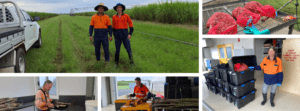
(Above left): Here, Sanjaya is directing Chuong to the field plots to be inspected. The stalks are cut into OES using a pair of electric secateurs (demonstrated by David Goodall) or with a twin bladed 1-eye saw (operated by Darren Browne). The OES are gathered into bags, labelled and dipped in fungicide before being packed into enclosed containers. They are then securely transported to DPI Redlands in Brisbane.
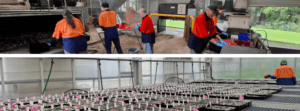
The photos below show the Brisbane team (l to r: Liz Wilson, Chuong Ngo, Niall Masel, Edwina Mills and Jon Hartas) potting up the one-eyed setts at the DPI facilities, and the finished result (bottom). Once planted, the seedlings are grown in the quarantine glass houses for four months. At the end of that time they will be sampled and disease tested by Liz Wilson before they can be sent to North Queensland to be planted out in propagation or arrowing plots for inclusion in trials in the following year.
Under the State’s biosecurity regulations, SRA has permission to move planting material for breeding and tissue culture activities if we meet certain conditions. Part of these conditions is that all cane grown in Biosecurity Zones 3,4 and 5 (Southern and Central Queensland) and cane grown in northern New South Wales, must go through a similar quarantine process at Redlands if it is destined to be planted in Biosecurity Zones 1 and 2 (North Queensland). Cane can safely come south from North Queensland but cannot go north without being quarantined because the southern areas have cane diseases not found in NQ.